The U.S. has very quietly revealed a previously undisclosed ship-hunting capability of the B-2 Spirit stealth bomber that might not draw many headlines, but will definitely get the attention of Chinese military planners.
Earlier this week, through an X post from the Air Force Global Strike Command, the U.S. Air Force announced that the B-2 Spirit can launch Lockheed Martin’s AGM-158C Long Range Anti-Ship Missiles.
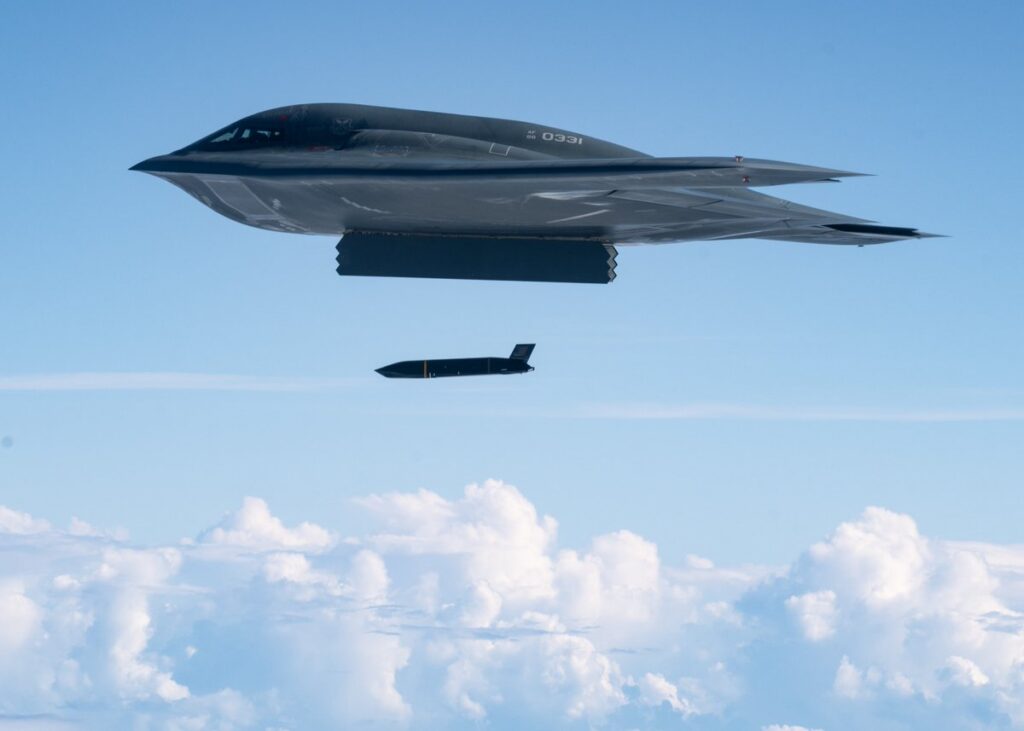
Notably, the service shared pictures of the B-2 dropping the missile in a live-fire, ship-sinking exercise in the Western Pacific.
The @PACAF successfully conducted a live-fire Sinking Exercise using the B-2 Spirit north of the Mariana Islands. Deploying the Long Range Anti-Ship Missile – demonstrating enhanced ability to achieve strategic objectives within range of potential threats.https://t.co/8PPP7bT3Pb pic.twitter.com/t2c0XTjfeo
— Air Force Global Strike Command (@AFGlobalStrike) June 29, 2026
Adding a new weapon to a bomber like the B-2 starts with software changes and mission system integration. It then continues with physical and mechanical integration that includes mounting hardware and connector buses. Drop tests are then conducted to ensure the weapon deploys properly and isn’t flung back into the aircraft by the slipstream. Then there’s a lot of flight testing that ultimately leads to operational certification. Overall, this is an expensive process that often takes years to complete.
As a result, we usually know about a new weapon being integrated into combat aircraft like the F-35 or B-2 a long time before the aircraft ever actually drops one. For example, we are now at least 19 months into flight testing the very same missile on the F-35C and so far, only the first phase of testing has been completed.
Yet, the U.S. is very good at keeping airplane-shaped secrets: it turns out, America’s heavy payload stealth bomber clearly started integration work on this weapon even earlier than the F-35 – so much earlier that it’s already slinging AGM-158Cs at a decommissioned Austin-class amphibious assault ship, the former USS Juneau.
The reveal is important because AGM-158C LRASM is arguably the most advanced and capable of Lockheed Martin’s stealthy Joint Air-to-Surface Stand-off Missile line.
This weapon is designed to have a small radar cross-section and is powered by an air-breathing turbofan engine, just like a fighter jet. This allows it to skim the wavetops as it closes with targets from upwards of 575 miles away. It delivers a 1,000-pound penetrating blast fragmentation warhead that’s designed to penetrate the exterior hull of a ship before detonating with the explosive equivalent of 50 Hellfire missiles – that’s more power than the Mk 48 heavy torpedoes carried by American attack submarines.
More terrifyingly, the LRASM was designed to fly and hunt autonomously in collaborative packs, using a combination of advanced onboard sensors and artificial intelligence. The missile uses GPS-supported inertial navigation to reach a general target area, meaning it can navigate even in jammed environments.
Then, once it reaches the vicinity of the enemy fleet, it switches over to onboard infrared electro-optical sensors that see the ships ahead of the missile. It then uses an onboard datalink to prioritize and distribute targets among the missile swarm for maximum effect, and then, it uses those same optics to identify the most vulnerable point on its assigned ship to make impact.
While details about this newly announced capability are limited, the LRASM has the exact same exterior form factor as its sister weapon, the AGM-158B JASSM-Extended Range. We know that the B-2 can carry 16 AGM-158Bs JASSM-Extended Range missiles, so we can reasonable expect that the bomber is also able to carry 16 LRASMs.
That means that a single stealth bomber could launch a pack of 16 stealthy AI-enabled cruise missiles at Chinese fleets from hundreds of miles away without anyone ever knowing it was there.
And when the B-2 wants to get a bit closer to enemy ships, it can turn to Boeing’s anti-ship JDAM cruise missile from upwards of 345 miles out, or the glide bomb version from 45 miles out.
In other words, the B-2 might just be the scariest ship-hunting platform on the planet today.
Read more from Sandboxx News
- Air Force solicits ideas for over 1,000-mile range weapon from industry
- Unorthodox firearms used by Ukrainian forces against Russia
- Red Light Randy was Delta Force’s crack Jumpmaster
- The F-22 fleet could last for longer than the U.S. would like – and that’s good news
- The military asked for a mortars app in 2015. It’s finally being fielded to Soldiers