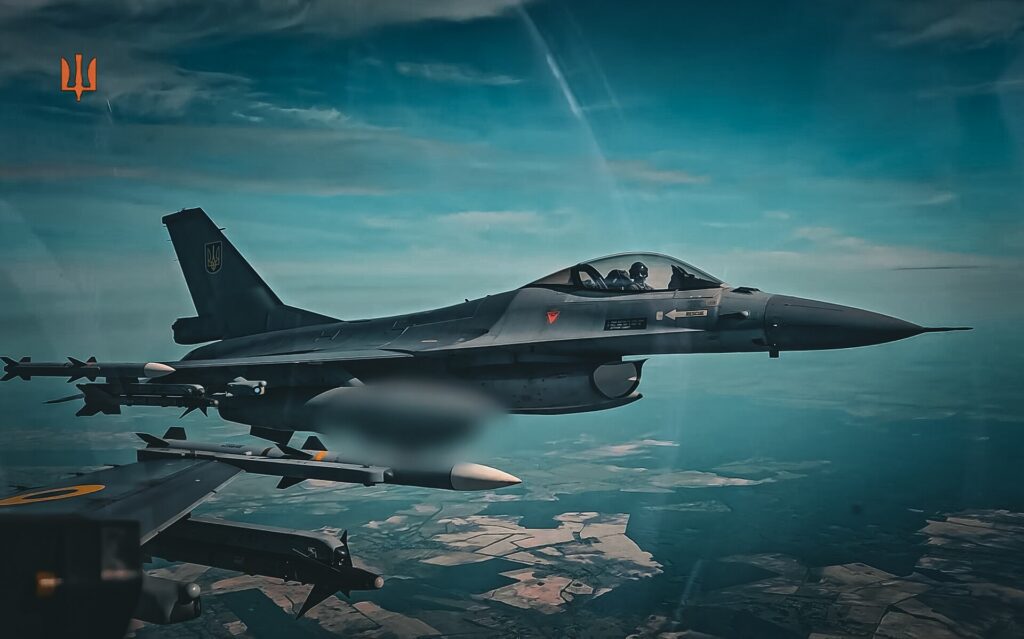
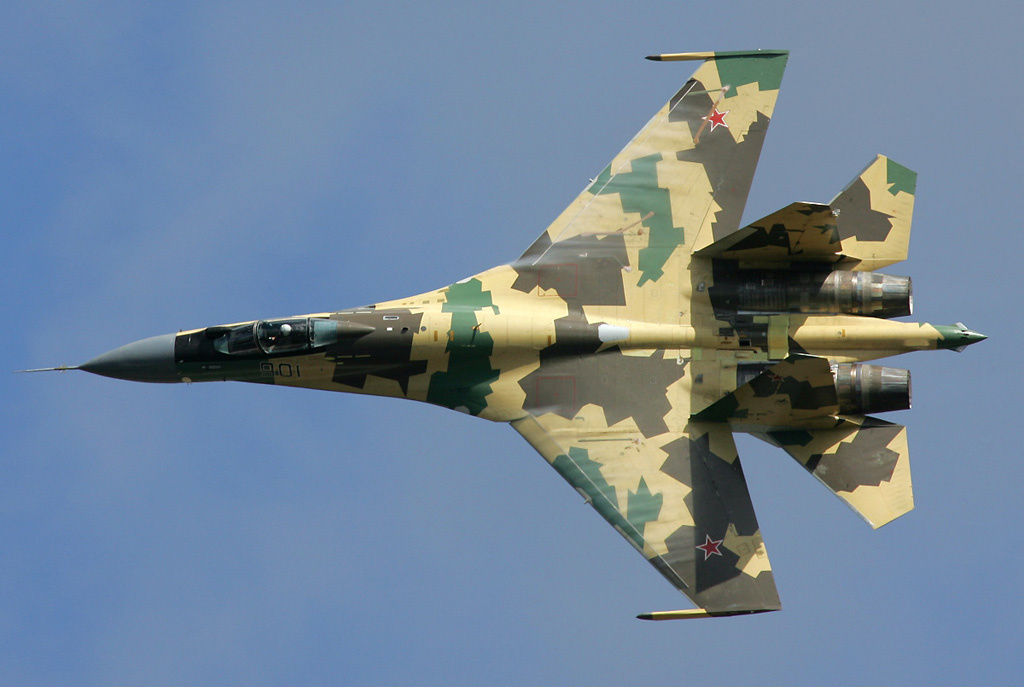
According to reports, a Ukrainian F-16 has successfully shot down a Russian fighter in air-to-air combat for the first time, and based on recent Russian losses, it appears the Russian jet may have been an advanced Su-35S multi-role fighter.
Official confirmation of the Ukrainian F-16’s air-to-air victory first came on Wednesday, when General Dan Caine, Chairman of the U.S. Joint Chiefs of Staff, testified before the Senate Appropriations Committee.
“I’ll note that recently we had the first air-to-air kill where a Ukrainian F-16 shot down a Russian fighter,” Gen. Caine said. “So I think their ability to scale their layered air defense has come a long, long way over the past couple of years with the help and assistance of many.”
General Caine did not confirm the type of Russian fighter that was shot down, but it has been confirmed in Russian media that an Su-35S was shot down in combat on July 8, and since then, rumors have surfaced that it was an Ukrainian F-16 that scored the hit.
The general’s statements do grant that rumor all the more credibility, but still fell short of overtly confirming the Su-35 was directly downed by the F-16.
Other rumors have suggested that the Su-35S was downed by a surface-to-air missile launched by an MIM-104 Patriot Air Defense System after being lured into its targeting envelope by Ukrainian F-16s.
So far, no conclusive evidence has surfaced to confirm either scenario.
In short, we have confirmation that an F-16 successfully shot down a Russian fighter recently, and confirmation that a Russian Su-35S was also shot down recently. So, while it’s reasonable to assume the two events are related, we cannot be certain.
The F-16s operated by the Ukrainian Air Force today would be flying at a distinct disadvantage against Russia’s much more modern Su-35S.
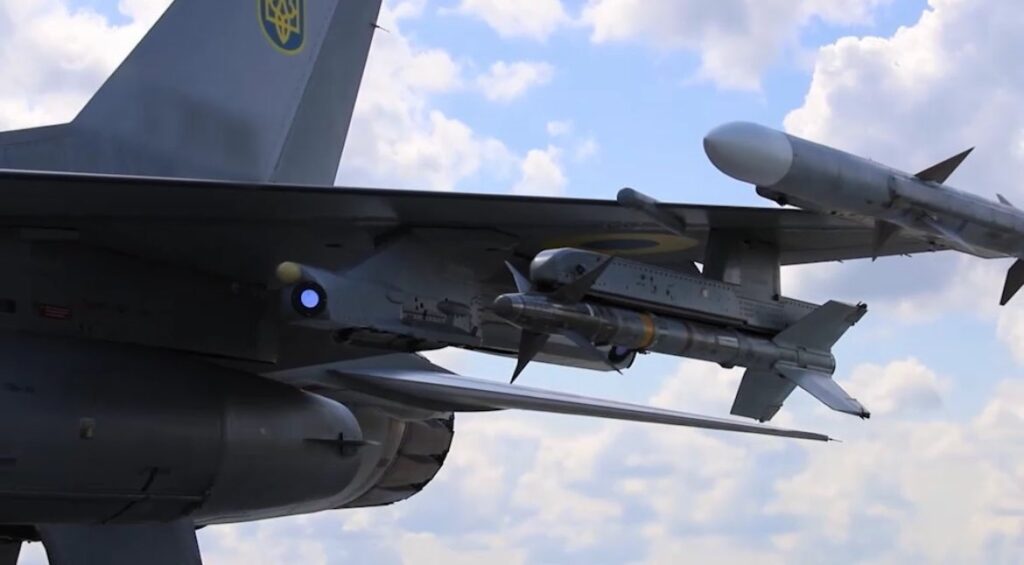
Ukraine’s F-16s were primarily sourced from the Netherlands and Denmark. These jets are all F-16AMs and BMs (one- and two-seaters respectively), which means they’re original 1970s-era F-16As and Bs that were later upgraded as part of the Mid-Life Update program. In short, Ukraine’s F-16s are more comparable to the aircraft operated by the U.S. Air Force in the early 2000s, rather than the much more modern and capable F-16Cs and Ds in service for the United States today.
Conversely, the Su-35S is among the most modern fighters in Russian service. While still maintaining some of the Su-27’s DNA, the Su-35S was practically a clean-sheet build, incorporating powerful new AL-41F-1S engines that provide better than a 1:1 thrust-to-weight ratio with a combat load, as well as thrust-vectoring nozzles that allow for incredible aerobatic capabilities. But it isn’t the Su-35’s dogfighting chops that make it such a threat to the small and nimble F-16 – it’s the avionics.
The Su-35’s Irbis-E is an X-band multi-mode phased array radar that might be a bit dated compared to the most modern active electronically scanned arrays found in American fighters today, but significantly outclasses the 90s-era AN/APG-66(V2) X-Band mechanically scanned arrays found in Ukraine’s F-16s.
This radar disparity is most apparent in terms of maximum detection ranges of fighter-sized targets.
Ukraine’s F-16s should be able to detect fighters from as far out as 83 kilometers in the presence of jamming, and likely a bit better than 150 kilometers without electronic warfare interference. The Su-35’s Irbis-E, on the other hand, has a reported detection range for targets with a radar cross section of three square meters (which is smaller than an F-16AM) of a whopping 400 kilometers.
That’s such a significant radar range advantage for the Su-35 that even a very conservative assessment would suggest a beyond-visual-range (BVR) fight would be hugely in the Russian jet’s favor.
The Su-35 also has the advantage in terms of beyond-visual-range weapons. The most advanced BVR weapons Ukrainian F-16s carry, to the public’s knowledge, are AIM-120C-8 AMRAAMs, which have a reported range of somewhere between 75 and 100 miles. The Su-35 often carries Russia’s R-77M, with a reported range of 120 miles.
Therefore, in combat, the Russian fighter can detect the F-16 first and fire its first shot before the F-16 can respond in kind.
But performance specs and hardware are not the only variables that determine combat outcomes: the circumstances of the engagement, supporting aircraft and systems, pilot skill level and training, and more can all tip the scales decidedly in one direction or the other.
Warfare is made up of countless incredibly complex operations playing out in an overlapping and contested environment, and that means the better jet doesn’t always win, and the worse jet doesn’t always lose. In warfare context is king.
Feature Image: A pair of Ukrainian F-16s, January 2026. (Air Force Command of Armed Forces of Ukraine)
Read more from Sandboxx News
- ACE operations: Deploying in theater is half the fight
- Anduril reveals ‘Thunder’ its large, attack drone meant to fly alongside Army’s Apache helicopters
- Delta Force loadout blues: Bringing the equipment you want on a rapid deployment isn’t always easy.
- The Trojan War is the backdrop to ‘The Odyssey,’ about a soldier’s post-war return home
- Bullpup rifles are reaching their end, despite their advantages