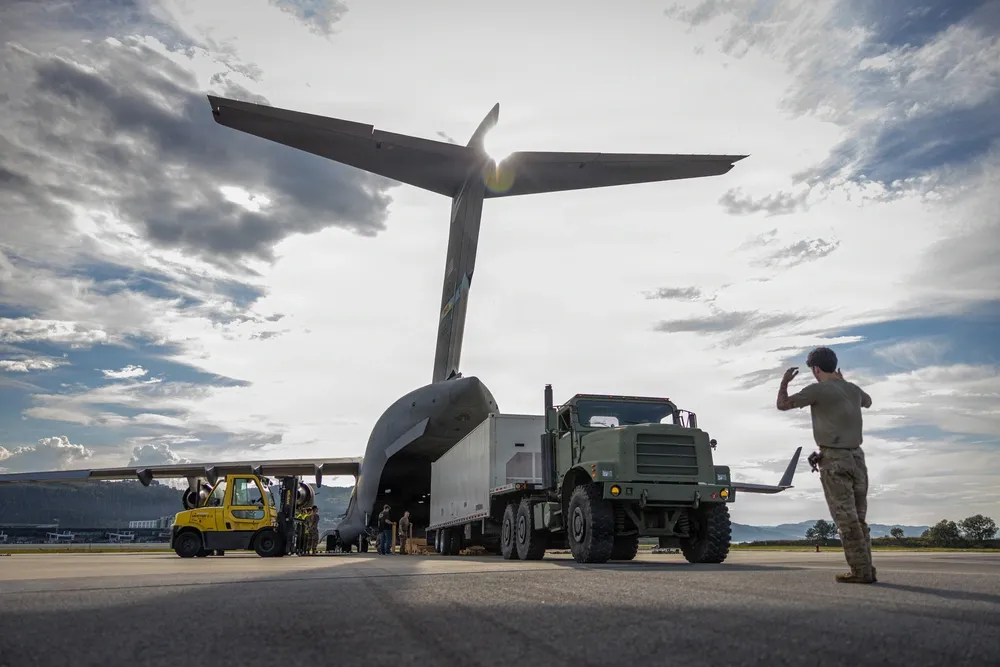
The U.S. military recently tested an innovative way to transfer and deploy Tomahawk land-attack cruise missiles during a large-scale exercise in Scandinavia.
For Operation Atlantic City 26, as the exercise was called, an Air Force C-17A Globemaster III transferred a four-cell Tomahawk Containerized Launching System to Norway to test expeditionary long-range fires capabilities.
The four-cell Containerized Launching System is a novel way to transfer and deploy one of the most capable land-attack cruise missiles in the world.
Derived from Lockheed Martin’s Mk 70 Mod 1 Payload Delivery System, the system is, essentially, a miniature vertical launching system – such as those found on guided-missile Ticonderoga-class cruisers and Arleigh Burke-class destroyers – fitted in a standard 40-foot container.
The U.S. Navy first tested the capability on board the USS Savannah, an Independence-class littoral combat ship, in 2023. One year later, it conducted land-based testing.
The deployment and fielding of the weapon system in Operation Atlantic City 26 is the third and final part in the capability’s validation, ensuring that the weapon system is air-transportable and able to be forward-deployed.
In addition to Tomahawk land-attack cruise missiles, the system can also support Standard Missile 6 (SM-6) air defense missiles.
Besides validating the transfer and deployment of the Containerized Launching System, Operation Atlantic City 26, as the exercise is called, tested the command-and-control networks necessary to fire long-range missiles from different locations around the world.
Modern warfare relies heavily on secure networks that can transmit battlefield intelligence and communicate operational orders to frontline units and forward-deployed assets. The military force that creates the most effective kill chain often prevails.
The Navy’s most important land-attack cruise missile
In service with the Navy since the early 1980s, the BGM-109 Tomahawk Land Attack Missile is the fleet’s primary long-range fires option.
Depending on the variant, the cruise missile can hit targets nearly 1,600 miles away. It flies at speeds of around 550 miles per hour and has the ability to fly close to the ground to avoid detection or interception by enemy air defense systems.
The missile can take different warheads, including a 1,000 lb blast/fragmentary unitary warhead or submunition warhead packed with cluster bomblets. Some older versions of the missile could also take a nuclear warhead, vastly increasing the strategic value of the Tomahawk.
The latest version of the Tomahawk (Block V) has upgraded navigation and communications features, allowing the missile to hit moving targets more easily and even loiter over the battlefield in search of targets of opportunity.
The Navy’s successful deployment and validation of the Containerized Launching System means that its most important land attack munition is now even more versatile.
Feature Image: A U.S. Air Force C-17A Globemaster III delivers a U.S. Navy Containerized Launching System to Trondheim, Norway, Aug. 27, 2026, to participate in Operation Atlantic City 26. The strategic airlift mission demonstrated the rapid projection of joint logistics and interoperable communication assets directly into the High North to sustain forward NATO forces. (Photo by Sgt. Noah Masog/U.S. Marine Corps Forces, Europe and Africa)
Read more from Sandboxx News
- Iran recovers Anduril’s Dive-LD sea drone, but its intelligence value is minimal
- What are Navy SEAL ‘duck’ insertions and which would you prefer?
- 5 of the weirdest traditions of the US military
- America’s massive military advantage nobody talks about: 600+ refueling aircraft
- USS Abraham Lincoln finally returns to port after extremely lengthy deployment – and yes, its rust is normal