It’s been a busy month for U.S. Navy ships.
Amid the announcement of President Donald Trump’s plans for a new “Golden Fleet” of expensive battleships, prospectively to start commissioning sometime in the 2030s, and the cancellation of the Constellation-class Frigate program, it might have been easy to miss a bit of good news for the Marine Corps: the approval of an official design for their long-desired littoral landing ships.
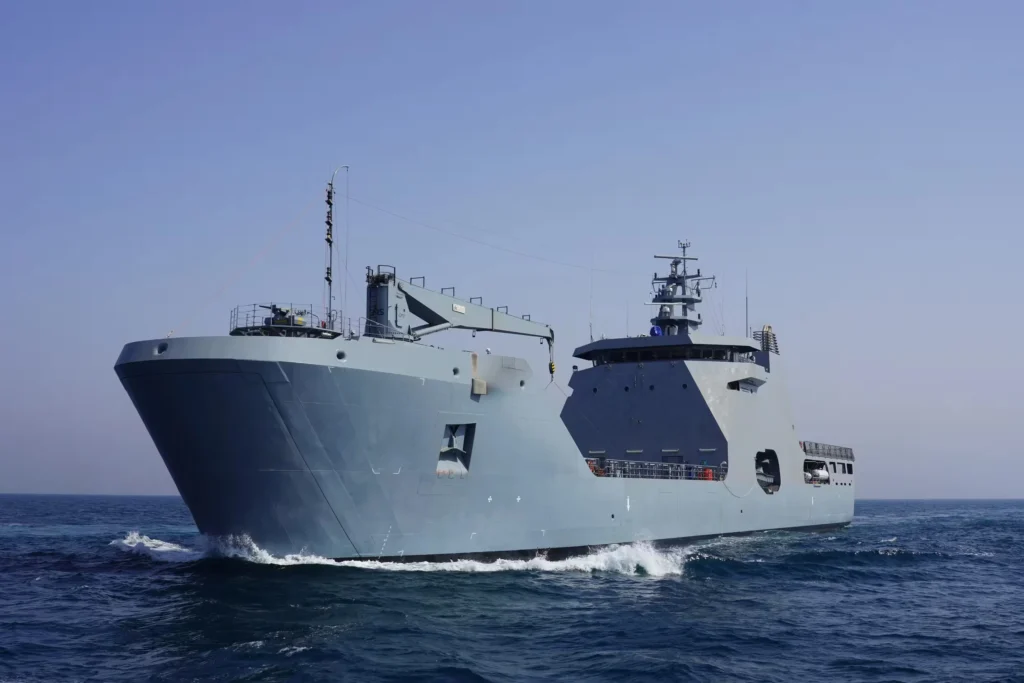
And the winner is Damen Shipyards’ LST-100. The Dutch company’s vessel measures about 330 feet (or 100 meters), has a helicopter deck, berthing for 18 crew members, and a range of about 4,000 nautical miles.
“The LST-100 delivers a high payload onto a secured beach and provides a flexible base platform for various operations,” Damen said in a description of the ship. “Once the beach is secure, the LST100 can rapidly provide an unmatched amount of operational assets … Alternatively, LSTs can operate independently and conduct amphibious operations using their reconnaissance capability to secure a beach for the main force on board.”
The vessel is currently in use by the Nigerian Navy and is in the process of being adopted by the Australian Navy as well.
The news comes almost exactly a year after the Navy announced it was canceling a request for proposals for the LSM after having determined that the plan it had was “simply unaffordable,” as Chief of Naval Operations Adm. Daryl Caudle put it in a video announcement this month.
The new plan will see at least 35 of these island-hopping ships built with construction to start in 2026.
The new ships will trade size and capacity for affordability and production speed.
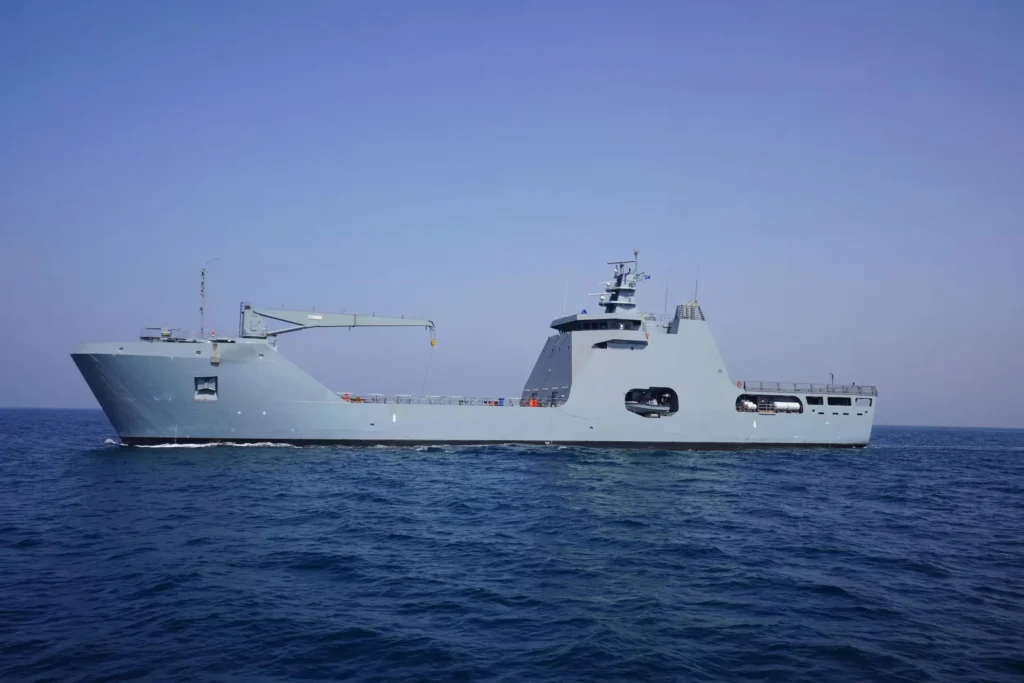
Previous mock-ups of the Landing Ship Medium had called for a crew of 70 with room for 50 Marine passengers and a length of 200-400 feet, two to four times the current LST-100 design. The range request has stayed consistent, though, with older documents indicating a need for upwards of 3,500 nautical miles in range, which the LST-100 satisfies.
In a joint video announcing the new ship design, Caudle joined Navy Secretary John Phelan and Marine Corps Commandant Gen. Eric Smith in hailing what Phelan called “the dawn of a new age for Navy shipbuilding,” emphasizing competition, cost safeguards, and maintainability that will keep the ship in service and out of long-term maintenance.
“For the Marine Corps, the medium landing ship will provide us with an organic, littoral mobility capability in the Indo-Pacific and around the world. It provides us with a critical intra-theater maneuver asset that is able to embark, transport and land Marines, supplies and equipment around the theater without requiring access to a pier,” Smith said.
Previously envisioned under the name “Light Amphibious Warship,” or LAW, the LSM has been described as one of the most important investments the Marine Corps wants to make to posture itself for Expeditionary Advance Base Operations, or EABO – its concept of small-footprint and agile maneuvering in the Pacific.
Related: Marines deploy new system to take out ships in the Pacific
According to a Congressional Research Service (CRS) briefing document, the ship would help sustain a “combat-credible” shore force; quickly transport forces from shore to shore in a contested environment; and project power and capability anywhere in the world.
“The survivability of LSMs would come from their ability to hide among islands and other sea traffic, from defensive support they would receive from other U.S. Navy forces, and from the ability of their associated Marine Corps units to fire missiles at Chinese ships and aircraft that could attack them with their own missiles (which can be viewed as an application of the notion that the best defense is a good offense),” the CRS briefing notes.
The initial LSM plan had the first ship costing as little as $100 million, but a report prior to last year’s cancellation increased the estimate to as much as $560 million – and $7.8 billion in total for 18 ships.
According to reports, the Navy has paid Damen $3.3 million for the technical data package for LST-100, allowing the service to better control costs and benefit from competition. Phelan said the Navy also plans to award a competitive contract to a vessel construction manager who will supervise the program “and facilitate genuine competition among multiple shipyards,” meaning more than one shipyard could be involved in building the new ships.
No cost estimate has been presented yet for the new ship production plan, but the timeline is holding steady, with construction expected to start in 2026 and delivery of the first ship in 2029. Also remaining in place is the naming strategy for the new ship class: it will be the McClung class, after Maj. Megan McClung, a Marine public affairs officer killed in combat in Al Anbar, Iraq in 2006.
Feature Image: Damen Shipyard’s LST-100 littoral landing ship. (Damen)
Read more from Sandboxx News
- Military buys more Mossberg 590A1 shotguns but chooses odd barrel length
- The X-15 was America’s first piloted hypersonic aircraft
- British warships will carry DragonFire laser to shoot down drones
- All the bonuses and benefits for troops in the new defense budget
- The incredible firepower of the US Army’s Night Stalkers