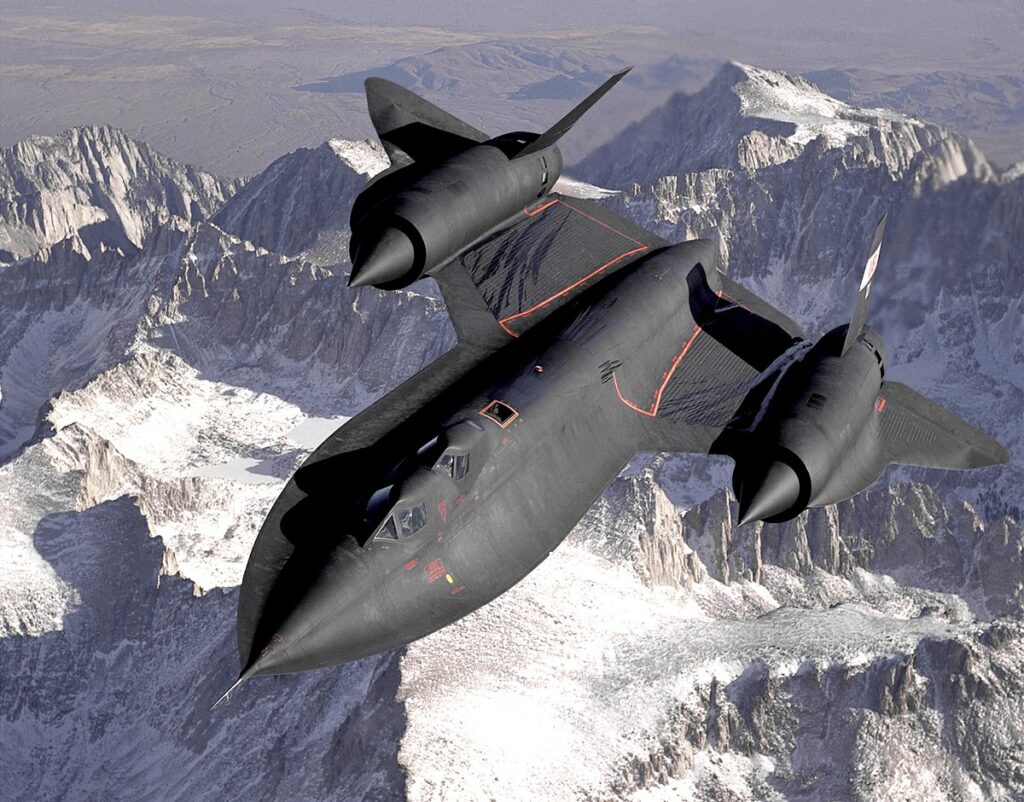
The last SR-71 Blackbird, the fastest piloted jet in history, has gone missing from NASA’s Armstrong Flight Research Center at the same time as NASA teased a new high-speed aircraft X-Plane program.
The disappearance of NASA’s former SR-71, tail number 844, was first noticed by Aviation Week‘s Steve Trimble. Using satellite imagery, Trimble was able to determine that the Blackbird was removed from its public display on Edwards Air Force Base by May 17 of this year.
This particular aircraft was the last SR-71 Blackbird ever built, originally carrying Air Force serial number 61-7980; it was also the last Blackbird ever to fly 27 years ago, when it reached Mach 3.21 at more than 80,000 feet over the airbase on October 9, 1999.
It appears as though the aircraft was transported into a hangar for inspection, and Trimble suspected that this unusual move could potentially be part of a return-to-flight program.
This specific aircraft would arguably be the best candidate for such a job, because Lockheed Martin – the jet’s manufacturer – only built 32 SR-71s of any type. Twelve of those were lost in crashes over the aircraft’s operational lifespan, and all but three jets permanently retired in 1990.
In January 1995, the U.S. Air Force brought two SR-71As back from retirement for a brief operational resurgence that ultimately ended in 1998; meanwhile NASA maintained a third SR-71 – the one that disappeared – as an operational high-speed research aircraft until 1999. That makes NASA’s Blackbird numbered 844 the closest thing to a flying SR-71 that there is left.
That alone would be an interesting development, but two weeks ago, Administrator of NASA Jared Isaacman made a noteworthy statement about the state of American X-Plane programs.
“As NASA recommits to flight test and works alongside industry to push the boundaries of airframe and propulsion design, it will not be long before NASA once again is flying as high and as fast as we had in decades past, and then even more,” NASA’s boss said.
And as Isaacman spoke, a very Blackbird-looking aircraft showed on screen behind him. When he was asked about it, he reportedly responded, “You sure that’s a Blackbird?”
However, even if the goal is to get this Blackbird flying again, actually doing so would be a massive undertaking.
After backing in the sun for nearly three decades, just making the airframe flight-worthy again could take a massive amount of work, with no production infrastructure for spare parts, no way to get good working engines, and even the aircraft’s specialized fuel, JP-7, no longer being produced.
Although all of these obstacles can be overcome with enough funds, this effort would be considerably harder, and more expensive, than the $100 million return to service these jets saw in the 1990s.
But, there is another possibility.
Maybe the Blackbird is just getting an aesthetic facelift so it can be rolled out alongside an SR-72 successor.
We know that Lockheed Martin had an aircraft in active development through March 2018, when both the Air Force and Lockheed Martin suddenly scrubbed all mention of the program from public-facing websites and press releases.
That program aimed to create an aircraft that could sustain speeds above Mach 5 using a turbine-based combined-cycle turbofan-to-dual-mode scramjet propulsion system that underwent ground testing in 2017. At the time, Lockheed officials said they aimed to have the aircraft in service by 2030.
Whether or not that is the reason the last SR-71 was removed, is yet to be seen.
Feature Image: An SR-71 Blackbird. (Lockheed Martin)
Read more from Sandboxx News
- How will I do when that time comes? Men in combat
- More NATO countries are buying a US-made interceptor that has downed thousands of Russian drones in Ukraine
- ‘Send me’ – 33 years after the Battle of Mogadishu
- Why would a Delta operator need to understand Einstein’s theories of relativity?
- How troops survive long deployments at sea