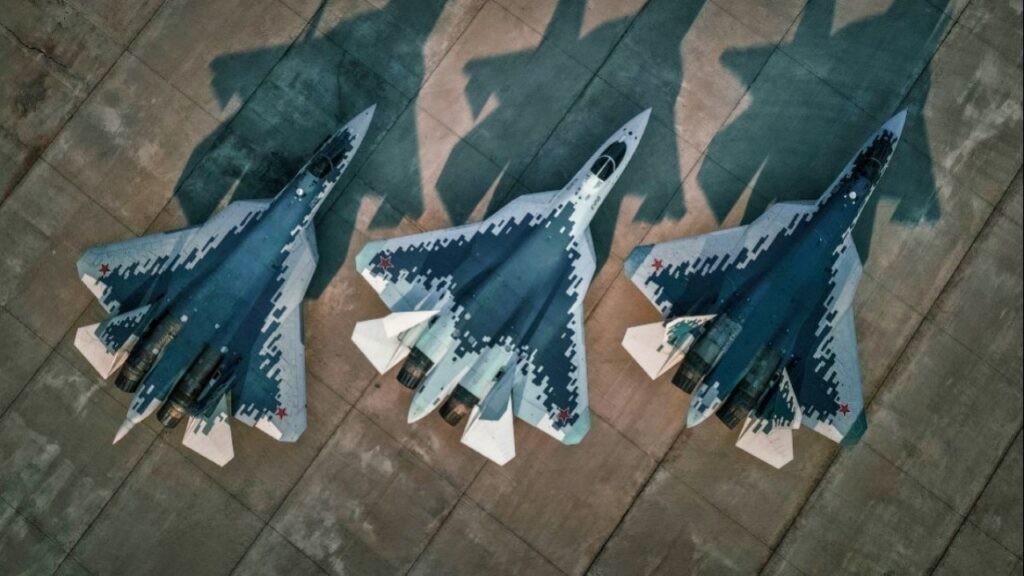
Two Russian Su-57 Felon fighters reportedly struck Odesa on August 23. The strikes were part of Russia’s sustained campaign against Ukraine’s principal Black Sea port and logistics hub.
The campaign has previously relied on one-way attack drones, ballistic missiles, and cruise missiles to degrade Ukraine’s port, rail, transportation, energy, and logistics infrastructure.
The Su-57’s involvement is new, however.
And while the inclusion of two specific aircraft doesn’t change the campaign against Odesa in a meaningful way, it does suggest that Russia’s Su-57 fleet is becoming numerous enough to use the fifth-generation fighter on fairly routine missions. This would be a significant development.
The Su-57 entered the war in Ukraine with fewer than a dozen operational aircraft. But estimates today place the fleet size at 50 to 60 aircraft.
That still leaves Russia far behind the U.S. or China in fifth-generation fleet size. But the Su-57 is now in a position to gain something neither the U.S. nor Chinese fifth-generation fighters have at meaningful scale: combat experience.
Odessa is a meaningful target. It’s not just another Ukrainian city but Ukraine’s principal Black Sea commercial gateway. Accordingly, Odesa links Ukrainian exports with global markets.
That’s why Russia has repeatedly targeted Odesa’s port infrastructure, rail lines, warehouses and logistics nodes, energy infrastructure, and transportation connections toward Moldova and the rest of Europe.
The strategic objective goes beyond destroying weapons shipments; a sustained attack could force Ukraine to disperse its logistical operations, raise transportation costs, consume air-defense interceptors, and require continuous infrastructure repairs.
It’s a long-game method to raise the cost of staying in the war.
Adding the Su-57 in the fight
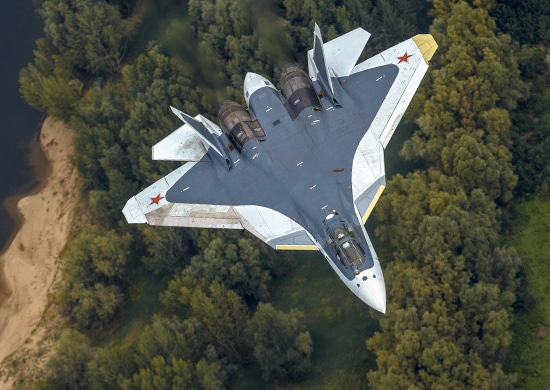
The Su-57 is Russia’s first operational fighter with fifth-generation technology, including a reduced radar signature, internal weapons carriage, advanced sensors, sensor fusion, super-maneuverability, electronic warfare, and long-range air-to-air and air-to-ground weapons.
Granted, the Su-57’s stealth performance is understood to be less comprehensive than either the F-22’s or F-35’s.
But the Su-57 is still a large, fast, maneuverable, long-range multirole fighter capable of carrying weapons internally and employing advanced sensors and EW. In all, it’s a formidable platform, regardless of whether the stealth matches the F-22’s.
According to reports, the Su-57 is outfitted with Kh-59/Kh-69-series cruise missiles for precision-strike missions.
The Kh-69 is relevant to the Felon, as it is a compact cruise missile designed for internal carriage, offering a roughly 300-km-class range depending on the variant and profile.
While subsonic, the Kh-69 offers terrain-following and low-altitude flight profiles, delivering a conventional warhead to fixed targets.
Because the Kh-69 can be carried internally, it helps preserve the Su-57’s low-observable characteristics allowing the jet to approach closer to contested airspace before launching the missile.
Related: Russia’s shadow fleet has increased its activity on British waters this year, Royal Navy says
The Su-57 can also be used as a SEAD/DEAD platform. Deploying the Kh-58 family of anti-radiation missiles, which can home on emissions from hostile radars, the Su-57 is adept in the SEAD/DEAD role. This creates something of a catch-22 for Ukraine: it can operate radars to find Russia’s low-observable aircraft, but by radiating, the radars increase the likelihood of being attacked.
The Su-57’s circumstances appear to have changed since the war began.
The jet entered the war as an immature platform, with fleet numbers so small that the Russians refused to subject the aircraft to the risk of damage for fear of losing an airframe.
But production seems to have expanded. And because the platform is being tested in a combat environment, feedback from that experience is being fed directly into the production process.
Still, the Su-57 has not been a workhorse of the war effort.
While the platform is combat-tested, it doesn’t mean the Su-57 is flying regularly in the most dangerous pockets of Ukraine. Russia still has strong incentives to protect the Su-57 from high-profile losses. The fleet size is still relatively precious.
And as export orders pick up, the Russians will want to preserve the idea that the Su-57 is advanced and hard to kill – a narrative that a shoot-down would complicate.
Editor’s Note: This article by Harrison Kass was originally published by 19FortyFive.com.
Read more from Sandboxx News
- Saab’s two-seater Gripen F successfully completes its maiden flight
- Air Commandos hone their glider skills in the High North
- Delta Force’s traditional endurance event tested operators mentally and physically
- What happens when you approach Mach 2 in an F-16?
- Marine Corps stands up group to train all its Marines on drone and counter-drone systems