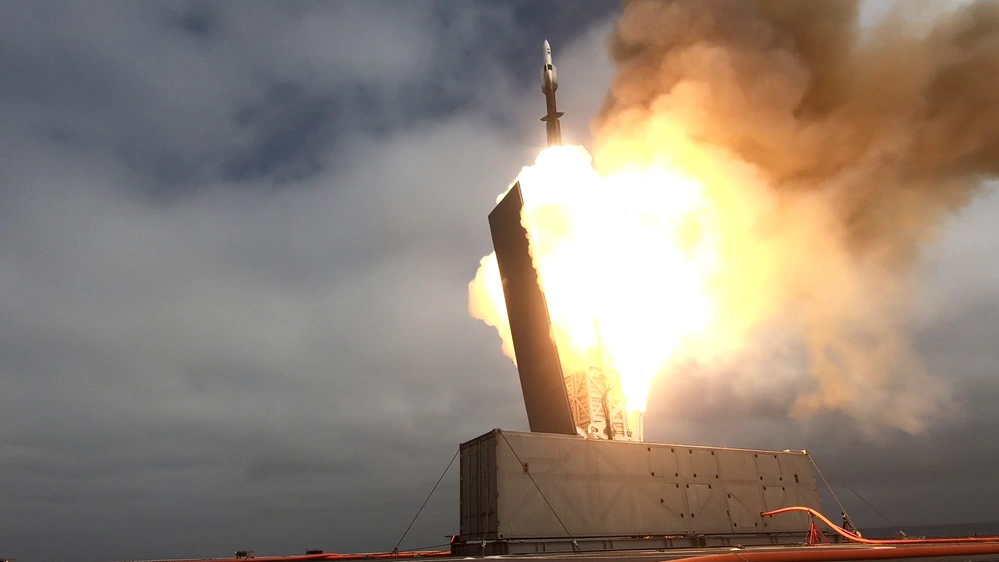
Last week, Raytheon announced that it will partner with the Pentagon to increase production of its interceptor missile, the SM-6, by nearly 300%. Under its new production target, it will aim to produce 500 SM-6 missiles per year. The company also announced that it will increase the production of other critical missile systems as well, including the Tomahawk, AMRAAM, SM-3 IB and SM-3 IIA.
“As global demand for these precision munitions continues to grow, these up-to-seven-year agreements establish frameworks to build on the company’s previous investments to expand production,” Raytheon said in its press release.
The SM-6, which stand for Standard Missile 6, is possibly the exception to the saying “a jack of all trades is a master of none,” because it has since evolved into much more than a ship-based interceptor.
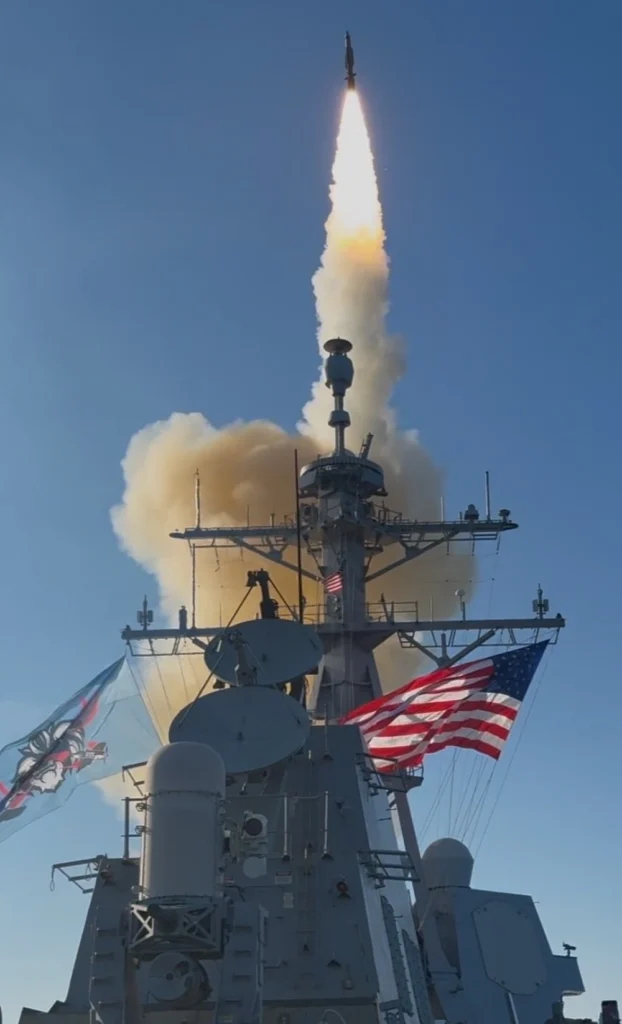
The system began its life as an extended-range air defense interceptor launched from the Mk 41 vertical launch systems on Navy vessels. In that role, it’s rated to bring down just about anything from slow-flying cruise missiles to ballistic missiles in their terminal phase. In fact, the SM-6 is currently the only in-service interceptor on the planet that’s considered capable of bringing down some types of modern hypersonic weapons.
The high-speed interceptor also offers a secondary surface-strike capability and can deliver a 140-pound blast fragmentation warhead to targets more than 290 miles (roughly 500 kilometers) out, at speeds in excess of Mach 3.5
The SM-6 is now also being employed by the U.S. Army in its container-based Typhon system, also known as the “Strategic Mid-range Fires System,” or SMRF. This is a four-cell vertical-launch system housed within a 40-foot shipping container, allowing the Army to launch SM-6s (as well as other weapons, like Tomahawks) at moving surface targets, like ships at sea. In July 2025, the Army demonstrated that capability when it sank a maritime target off the Australian coast with a Typhon-launched SM-6 at an undisclosed range.
However, the most famous secondary application of the SM-6 has to be in its air-launched form as the Navy’s recently revealed AIM-174B Gunslinger.
These beyond-visual-range air-to-air missiles eliminate the initial rocket booster used to propel the missile out of a ship, effectively using the Navy’s F/A-18 Super Hornets for the same job. As a result, AIM-174s launched by high-flying fighters all but certainly offer even greater range than the weapon can provide in surface-launched form, potentially making it capable of downing airborne targets more than 300 miles out.
The SM-6 has been in service, in one form or another, since 2023, but aside from some broad figures, Raytheon has largely chosen not to disclose annual production rates.
An unclassified comptroller document from 2024 give us a sense of deliveries to the U.S. military. According to it, Raytheon had already delivered a total of 856 SM-6s by 2023; these were split between original Block 1 weapons and the upgraded Block 1As that entered service that year. That report also went on to identify 2024’s total SM-6 procurement at 125 AURs (short for all-up rounds, or complete systems), with production continuing to ramp up on Block 1As and even newer Block 1Bs to reach 300 AURs in fiscal year 2028.
Feature Image: USS Savannah (LCS 28) conducts a live-fire demonstration in the Eastern Pacific Ocean utilizing a containerized launching system that fired an SM-6 missile from the ship at a designated target. The exercise demonstrated the modularity and lethality of Littoral Combat Ships and the ability to successfully integrate a containerized weapons system to engage a surface target. (Commander, Naval Surface Force, U.S. Pacific Fleet)
Read more from Sandboxx News
- German military goes against tradition and chooses a non-German weapon as its new handgun
- US embraces ‘Shanzhai’ with copycat Iranian drone
- American submarine sinks Iranian frigate and achieves Navy’s first torpedo kill since WWII
- F-35 gets its first ever air-to-air kill against a manned aircraft
- A Delta Force parachute saga