On February 20, six months after its announcement to do so, Poland withdrew from the Ottawa Treaty which bans anti-personnel mines.
The Ottawa Treaty, which is signed by 133 countries and came into effect in 1999, prohibits the use, production, selling, and stockpiling of anti-personnel mines on humanitarian grounds. Other types of mines are not prohibited under the treaty.
Poland signed onto the treaty in 2012 and by 2016 it had dismantled its entire stockpile of anti-personnel mines.
The country now joins Finland, Estonia, Latvia, and Lithuania in withdrawing from the treaty – Warsaw’s four NATO allies left the treaty in 2025. Ukraine is also set to withdraw from the treaty.
These countries have left the Ottawa Treaty over concerns about Russian aggression, Jason Moyer, a non-resident fellow at the Atlantic Council think-tank told Sandboxx News.
Poland and Lithuania border Russia’s Kaliningrad exclave and Belarus – a staunch Moscow ally. Finland and the two other Baltic countries border Russia to the east. Russia is not a party to the treaty.
“The decision to leave a landmark global treaty and return to landmines for defensive use signals both the current threat environment facing NATO’s eastern flank, as well as demonstrates the ends to which these countries will go to ensure their territorial defense,” Moyer said.
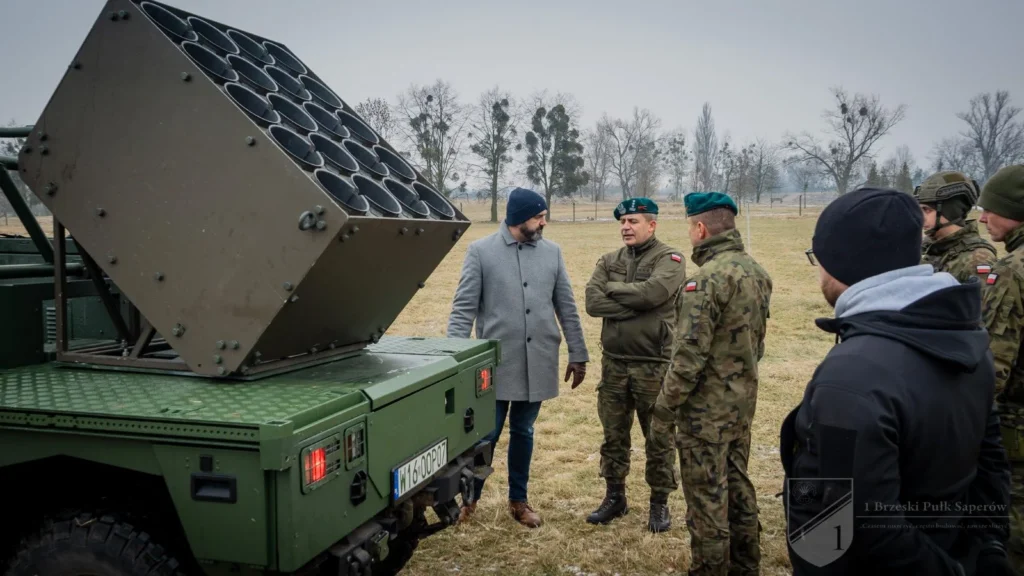
Indeed, as his country was exiting the treaty, Polish Prime Minister Donal Tusk revealed the Bluszcz, a mine-laying vehicle that can be operated unmanned or manned and rapidly lay mines.
Bluszcz can deploy up to 100 mines per sortie and be preprogrammed to lay mines along specific paths and at specific intervals.
Tusk said that Poland is in the process of finalizing its “mine project” which falls under the country’s East Shield program that aims to fortify its eastern border with active and passive defense measures. The program is scheduled to be completed by 2028.
In the event of a threat, Poland will soon be able to mine the its border within 48 hours, Tusk added.
“It’s important for these countries to have all options available to defend [themselves],” Moyer said.
For the Baltics, with their small population relative to the Russian military, landmines are seen as a good trade-off in capabilities versus population,” Moyer told Sandboxx News. In the event of a conflict, its better to use landmines than to station troops along the border, he explained.
More countries might withdraw from the Ottawa Treaty, Moyer said, particularly countries on Europe’s eastern flank, like Romania, Slovakia, or maybe Hungary.
However, leaving the treaty only makes sense strategically if you have a large land border with a potential aggressor and minimal population in the region you intend to mine. This – and diplomatic pressure from Canada – makes it unlikely that many other NATO countries will follow Poland’s path, Moyer added.
Feature Image: Poland’s Bluszcz mining system. (Milmag.pl via Polish 1st Sapper Regiment)
Read more from Sandboxx News
- Ukrainian counteroffensive is making ground and easing pressure on country’s defenses
- Army pilot shot three times during the Maduro Raid just received the Medal of Honor
- Lockheed Martin reveals F-22’s new stealth fuel tanks during Warfare Symposium
- Northrop Grumman and Air Force agree to expand B-21 production capacity as program performs well
- DARPA’s new Longshot missile will begin testing this year, the agency says