In January, the Department of Defense released the 2026 National Security Strategy (NSS). The document outlines how the Pentagon perceives the most important threats around the world and the methods in which it will seek to counter them.
Even the unclassified version of the NSS provides some interesting insight into the Pentagon’s strategic thinking. It is especially elucidating with regard to the threat coming out of China.
In the 2026 NSS, the Department of Defense recognizes China as the second most powerful country and military in the world behind the United States. But it goes further than that to say that China has been the most powerful country relative to the U.S. since the 1800s. This designation indirectly states that China is currently presenting a bigger threat to U.S. national security than Imperial Japan and Nazi Germany during WWII, or the Soviet Union at the height of the Cold War.
“While China faces very significant internal economic, demographic, and societal challenges, the fact is that its power is growing,” the National Security Strategy states.
The Chinese Communist Party spends hundreds of billions on its defense capabilities every year. The high defense spending often comes at the cost of domestic needs. Indeed, the Chinese military is undergoing one of the largest military modernization and buildup processes in modern history. Every year, Beijing adds new fighter jets, strategic bombers, missile-guided destroyers, submarines, and even aircraft carriers to its roster.
“Indeed, the speed, scale, and quality of China’s historic military buildup speak for themselves, including forces designed for operations in the Western Pacific as well as those capable of reaching targets much farther away,” the NSS adds.

However, the U.S. does not seek a conflict with China. “President Trump seeks a stable peace, fair trade, and respectful relations with China, and he has shown that he is willing to engage President Xi Jinping directly to achieve those goals,” the NSS states.
Yet, to negotiate and ensure favorable outcomes, one must be in a position of strength. Foreign affairs can be brutal, especially when dealing with autocratic countries like China. Strength is respected, while indecisiveness and division are seen as weaknesses.
“Our goal in doing so is not to dominate China; nor is it to strangle or humiliate them. Rather, our goal is simple: To prevent anyone, including China, from being able to dominate us or our allies – in essence, to set the military conditions required to achieve the NSS goal of a balance of power in the Indo-Pacific that allows all of us to enjoy a decent peace,” the Pentagon’s strategy states.
To enable that goal, the Pentagon wants to create a strong denial defense along the First Island Chain that will contain Chinese military aggression.
But U.S. strategy in the region is versatile, and allies and partners play an important role. To that end, the 2026 NSS places heavy emphasis on America’s allies spending and doing more for the collective defense.
China clearly represents the largest threat to U.S. national security. But an open confrontation is not necessarily the right course of action. The Pentagon recognizes that and invests in deterrence through strength.
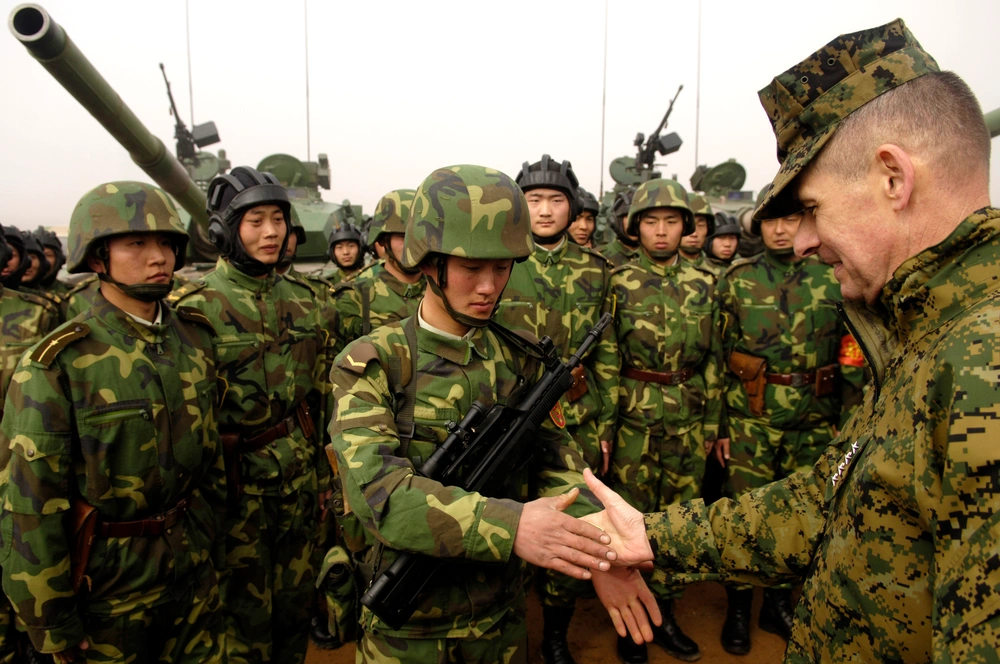
Feature Image: Marine Gen. Peter Pace, then chairman of the Joint Chiefs of Staff, right, shakes hands with Chinese tank soldiers with the People’s Liberation Army on Shenyang training base, China, Mar. 24, 2007. (Photo by Staff Sgt. D. Myles Cullen/Department of Defense)
Read more from Sandboxx News
- Project MAHEM was DARPA’s attempt at destroying armor by using electromagnetism
- The military wants to deploy ‘walking blood banks’ – and that’s a big deal
- America’s attempts at creating internally suppressed ammunition during Vietnam
- 22nd Marine Expeditionary Unit will be first Marine formation to get attack drones
- Military tests high-tech ways to ensure troops on the frontlines are fed