In early December, Mossberg announced that the United States military is planning to purchase $11.6 million worth of 590A1 shotguns.
The military has been using the Mossberg 590 series since 1987. Every so often you hear rumors that it’s going to replace the old pump-action warhorse, but they don’t ever come to fruition.
The 590A1, which is an evolution of the original 590, aims to be incredibly rugged and durable and comes with features like a heavy walled barrel, as well as a bayonet lug, and metal trigger guard.
The 590A1 has a pump-action design, meaning you need to manually pump the gun between shots. Pump shotguns are often favored for their reliability, durability, and their ability to handle a multitude of ammunition types that semi-auto shotguns are not capable of firing reliably.
The 590A1 features modern pump-action features, including twin action bars designed to resist binding and a skeletonized elevator that allows shooters to easily clear jams and helps prevent them. The shotgun also has dual extractors, an aluminum receiver, and a tang-mounted ambidextrous safety. The 590A1 also features a parkerized finish to keep rust at bay.
The 590A1 comes in many configurations and stock designs. Surprisingly, the configuration chosen by the military will be a 12-gauge gun with a 17-inch barrel – an odd choice that’s outside the norm.
Most Mossberg 590A1 variants designed form military, police, or general tactical use have one of three barrel lengths: 18-inches that tend to be the normal length; 14-inches that makes the gun more maneuverable and is the shooter option; and 20-inches which allows for a longer magazine tube. Breaching options are niche, but might have an even shorter barrel.
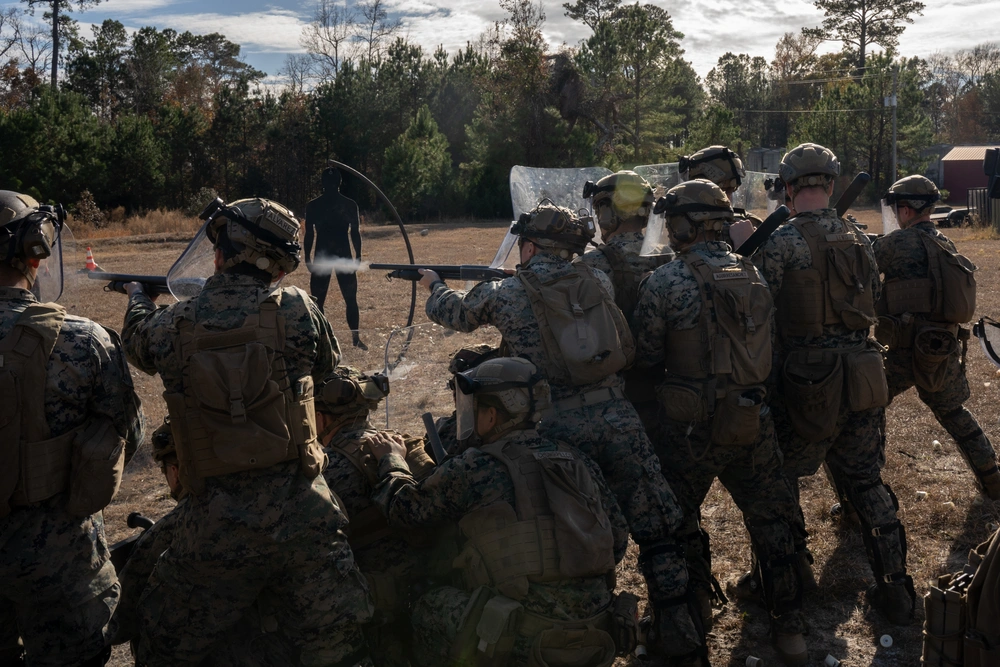
The 17-inch barrel length was originally designed to work with weapon racks in submarines. Submarines have strict space requirements so trimming an odd inch off the barrel made it easy to keep the weapons locked in the armory until needed.
The purpose of the purchase
Sandboxx News reached out to Mossberg and confirmed that the military is purchasing the guns for use as counter-drone weapons. This appears to be one of the first times the military has purchased shotguns purely for the anti-UAS role.
The guns will be employed to take down small, commercial grade drones and will be using two-ounce tungsten shot to do so.
The two-ounce tungsten load is a number 9 birdshot load. This is an extremely small pellet, making it ideal against drones since hundreds of pellets can fit in the shell. Two ounces of tungsten will likely need a three-inch shell which can fit over 900 micro sized pellets. Drones are fairly sensitive and it doesn’t take much to disable one: a single pellet to the rotor will send it to the ground.
Additionally, tungsten is an incredibly dense material making it heavy for its size which, in turn, will help increase the pellets’ penetration. Cheap it is not, but effective it can be.
The ideal range of these guns and load is 40 to 60 yards. The acceptable kill zone is 90% of the tungsten shot in a 20-inch circle at 50 yards. The 590A1 uses a heavy walled barrel which tends to create tighter patterns overall, so it will work fairly well for this role.
Related: The slick custom shotgun carried by a Navy SEAL point man in Vietnam
Benefits of a longer barrel
I’m of the notion that a longer barrel would make a better gun for flying threats.
Historically guns that shoot skeet or birds have longer 26- to 30-inch barrels. Longer barrels are more desirable for shooting moving targets because they allow for a smooth, steady swing.
Longer shotgun barrels allow for a longer sighting plane, which makes it easier to align the gun’s path with the target’s flight path.
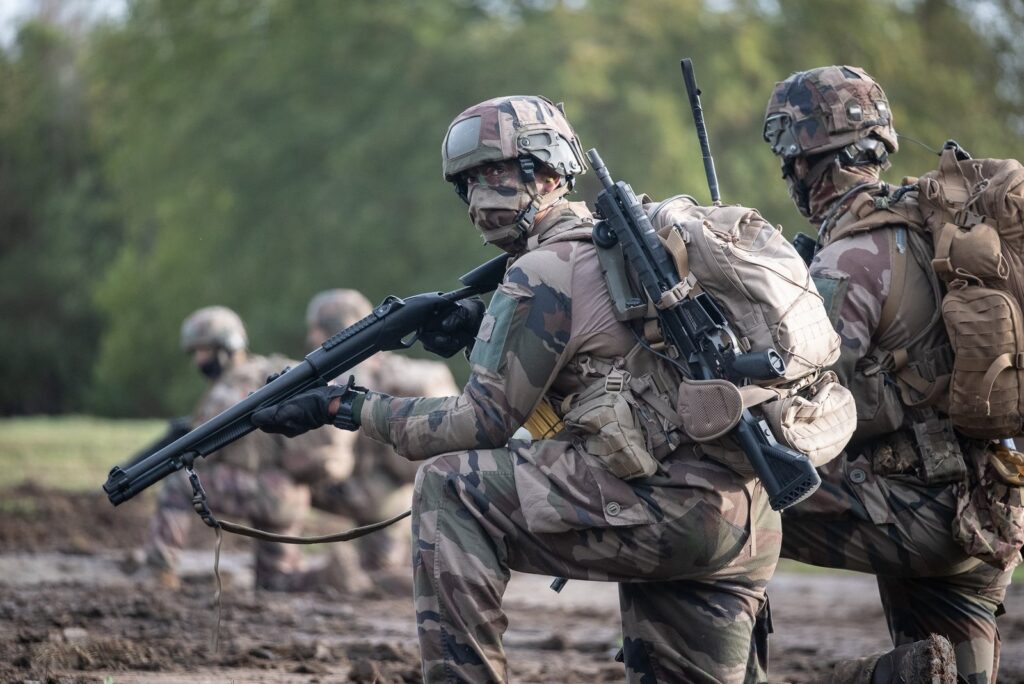
The longer barrel also offer better follow-through and their weight creates more momentum that keeps carrying the gun as the shooter pulls the trigger making it easier to shoot moving targets. The French famously adopted various SuperNova shotguns from Benelli with 28-inch barrels for counter-drone use and it’s easy to understand why.
On the other hand, shorter barrels start and stop quickly, which is great for close quarter’s combat, but it makes it harder to shoot fast moving, flying targets.
That brings us back to the military’s unusual choice of a 17-inch barrel. While not optimum for hitting moving flying targets, any shotgun is still a good option to take out drones. As the war in Ukraine has demonstrated, Ukraine’s military uses several different shotguns with various lengths to hit and destroy Russian drones.
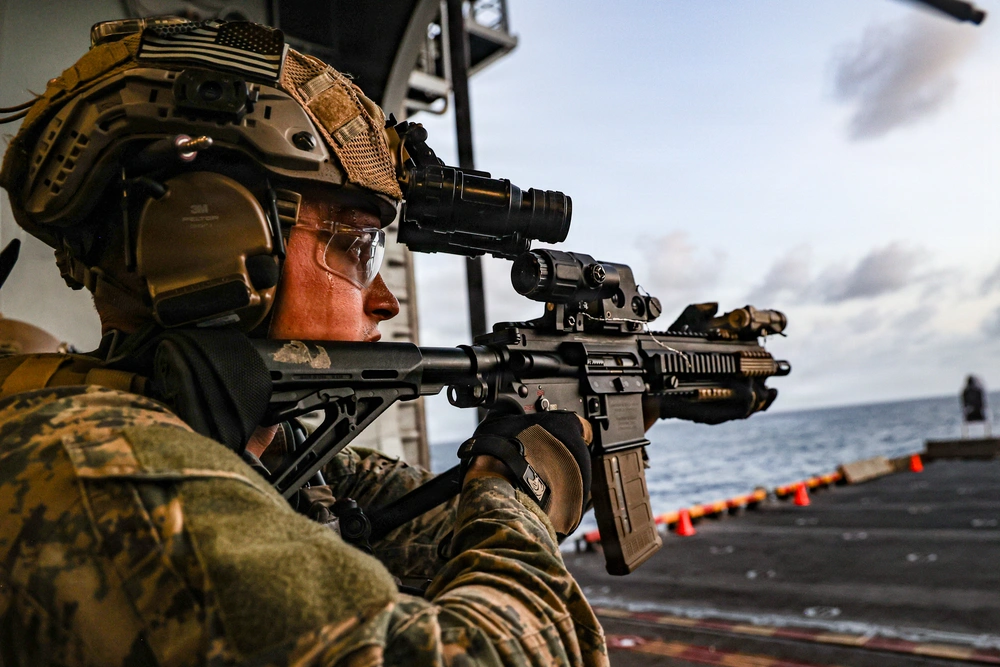
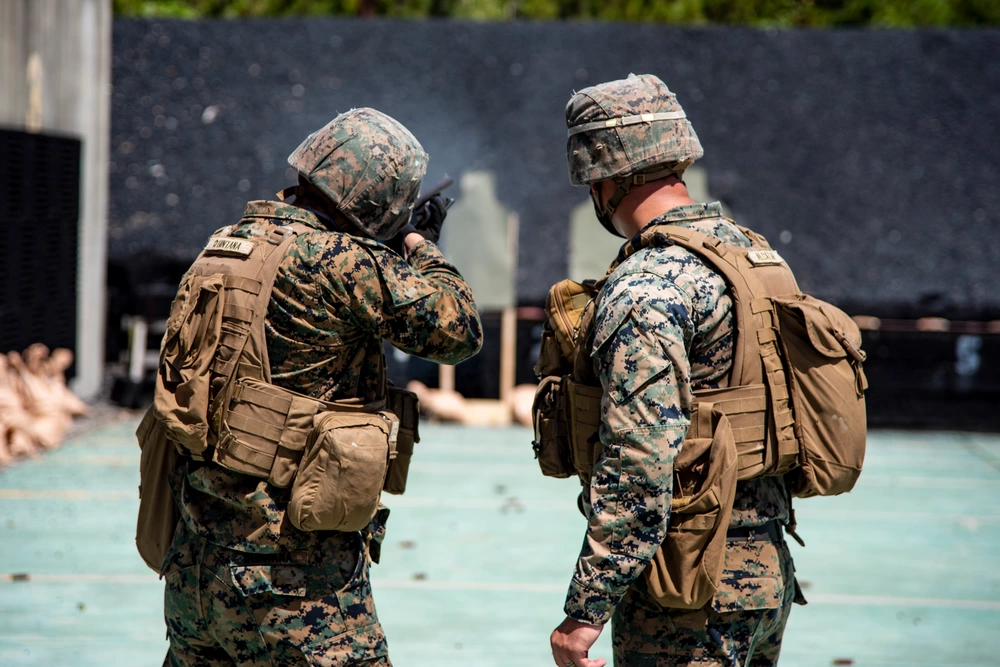
Feature Image: A Marine with Charlie Battery, Battalion Landing Team, 2nd Battalion, 4th Marines, 31st Marine Expeditionary Unit (MEU), fires a Mossberg 590A1 during a shotgun range at Camp Hansen, Okinawa, Japan, July 24, 2020. (Photo by Sgt. Joshua Brittenham/U.S. Marine Corps)