On Thursday, Lockheed Martin and the Pentagon announced a framework deal to fund the procurement of 850 new F-35s over the next 10 years.
This deal doesn’t necessarily shift the topline number of F-35s the U.S. ultimately intends to buy, but rather dramatically shifts the way in which it goes about buying them.
Fighter purchases today are commonly negotiated by production lots, or batches, of usually between 140 and 170 jets. The aircraft sometimes even see updates, upgrades, or other changes between production lots (like the upgraded onboard computing hardware delivered from Tech Refresh 3 starting in Production Lot 15 just a few years ago).
The problem with negotiating contracts for each batch of about 150 fighters is that it can create a lot of financial and logistical instability for production when the Pentagon and Lockheed Martin find themselves in protracted discussions, as has occurred several times in the past.
In 2016, for example, after 14 months of stalled negotiations, the Pentagon finally forced a unilateral contract action, effectively forcing Lockheed to deliver 57 aircraft at a price point the firm did not agree to – the largest such unilateral contract action in U.S. military history – to prevent negotiations from delaying Lot 9 production.
Then, in 2022, negotiations over Lot 15 stretched six months beyond schedule, creating hundreds of millions of dollars in contractor liability for Lockheed (which had to keep sourcing components for those jets from subcontractors as negotiations stalled).
And in 2024 and 2025, negotiations once again stretched on for months longer than the program’s funding could accommodate. This time, Lockheed Martin had to temporarily fund the purchase of roughly $400 million worth of aircraft materials the federal government was actually supposed to pay for, just to keep fighter production moving.
In all, instability around contract negotiations ultimately cost Lockheed Martin gobs of money in first, second, and third-order effects when it comes to managing subcontractors and purchasing long-lead components in advance,
To prevent similar problems from reoccurring, this new procurement approach hashes out funding for production and sustainment over the next 10 years, covering production lots 21 through 30, or a total of 850 F-35s.
In response to this 10-year agreement, Lockheed announced plans to invest at least $7 billion into various efforts to better support production and long-term sustainment of the jet.
Therefore, it is probable that contract instability and payment delays would likely cost Lockheed more than $7 billion over the coming decade, had not the agreement with Pentagon happened, making the $7-billion investment a better deal for stockholders and the company. in the long run.
In short, this framework agreement, if funded by Congress, would alleviate several problems and keep the F-35 faucet turned on for at least a decade.
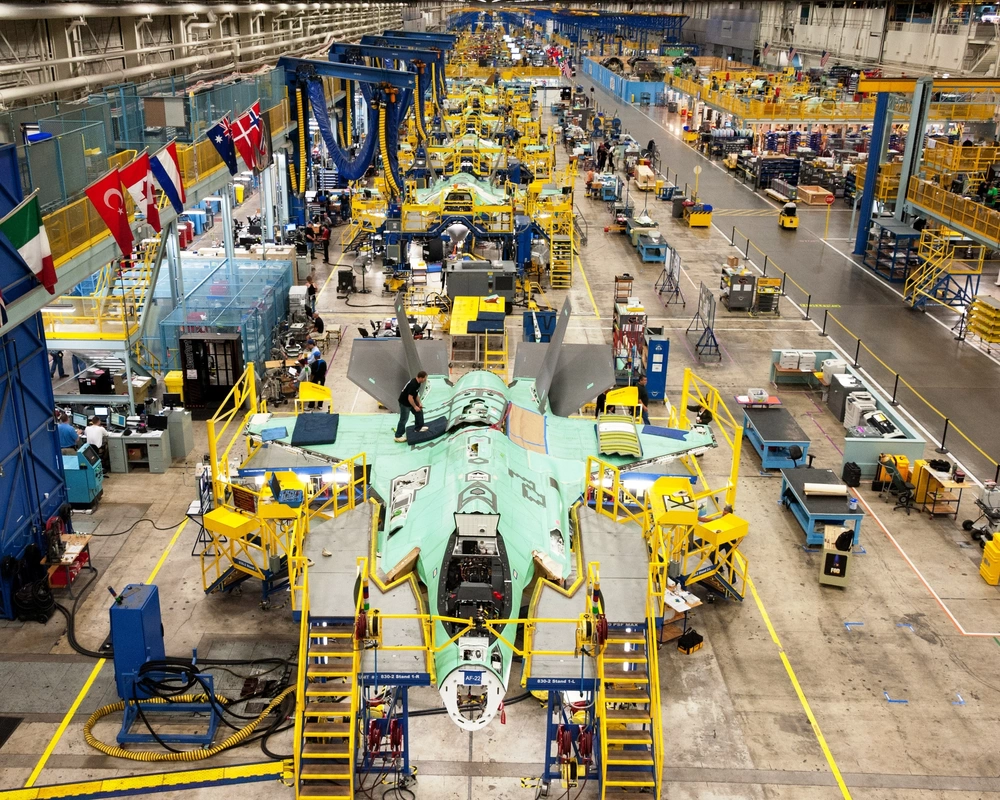
Feature Image: An F-35 assembly line at Lockheed Martin’s factory in Fort Worth, Texas, 2012. (Photo by Fred Clingerman/Marine Corps Air Station Yuma via Lockheed Martin)
Read more from Sandboxx News
- The secret inspiration behind Jimmy Stewart’s upcoming biopic was a still-flying B-24 Liberator
- The Marine Corps has a boot problem
- Anduril’s Ghost Shark autonomous submarine just made a huge splash
- Is India’s INSAS the worst assault rifle ever made?
- F-22 takes control of Anduril’s FQ-44 Fury drone for the first time