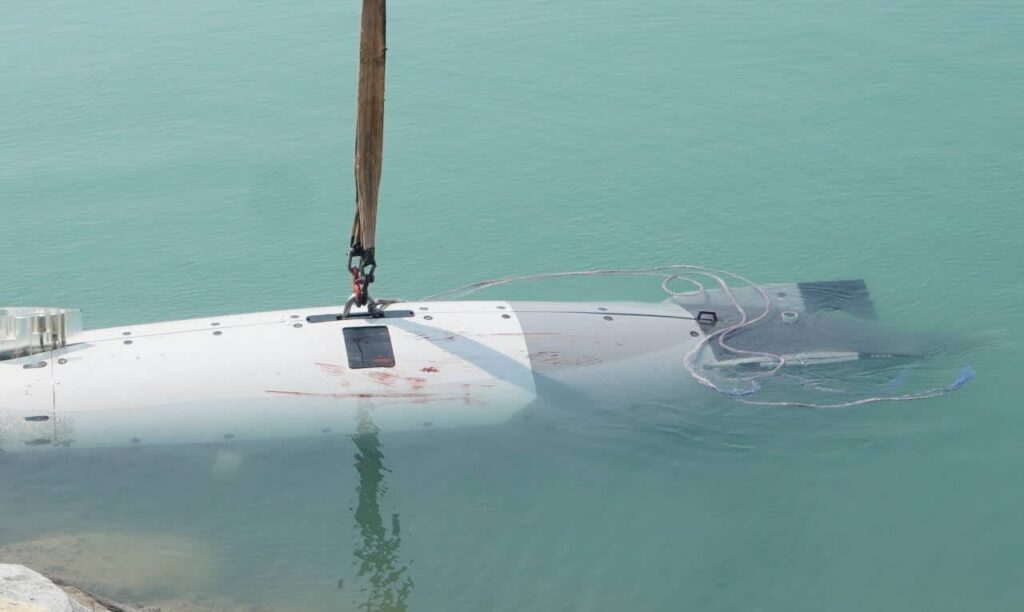
Iranian forces are claiming to have recovered a U.S. Navy drone submersible that appears to be Anduril’s Dive-LD.
The claim comes from Iran’s Islamic Revolutionary Guard Corps, or IRGC, a group that isn’t renowned for the veracity of its claims. However, this time, IRGC’s claims come with photographs and a video that depicts a drone closely resembling Anduril’s Dive-LD, which is a platform we knew was in testing with the Navy, but, to this point, has not been disclosed as being in active service.
Iranian-links accounts are playing up the potential intelligence value of the recovery, and while the system isn’t as advanced, there’s still intelligence value to be gathered.
At around $2.5 million a piece, each Dive-LD rings it at around the same price as a Tomahawk cruise missile, and just a bit more than a top-of-the-line AMRAAM.
The Dive-LD is a 19-foot-long autonomous submersible that, like many of Anduril’s offerings, isn’t designed to deliver the latest and most advanced technology, but is instead meant to deliver proven capabilities at scale – meaning on a budget and in large volume.
This electric-powered platform has a maximum endurance of about 10 days; can dive to a maximum depth of an incredible 6,000 meters (or almost 20,000 feet); and offers roughly one cubic meter of payload space to carry a large variety of sensors and payloads.
The drone is designed to map the ocean surface, or, in places like the Strait of Hormuz, assist in identifying undersea mines and other objects. As such, it is relatively small for ease of logistics, and is meant to be deployable from nearly any platform.
The system first piqued the Navy’s interest in 2023 as a practically off-the-shelf option for undersea intelligence, surveillance, and reconnaissance. It made its debut in undersea combat exercises in March 2024. In August of that year, it appears as though the Pentagon selected the Dive-LD for its replicator initiative, which aimed to field large numbers of relatively inexpensive drone systems in short order.
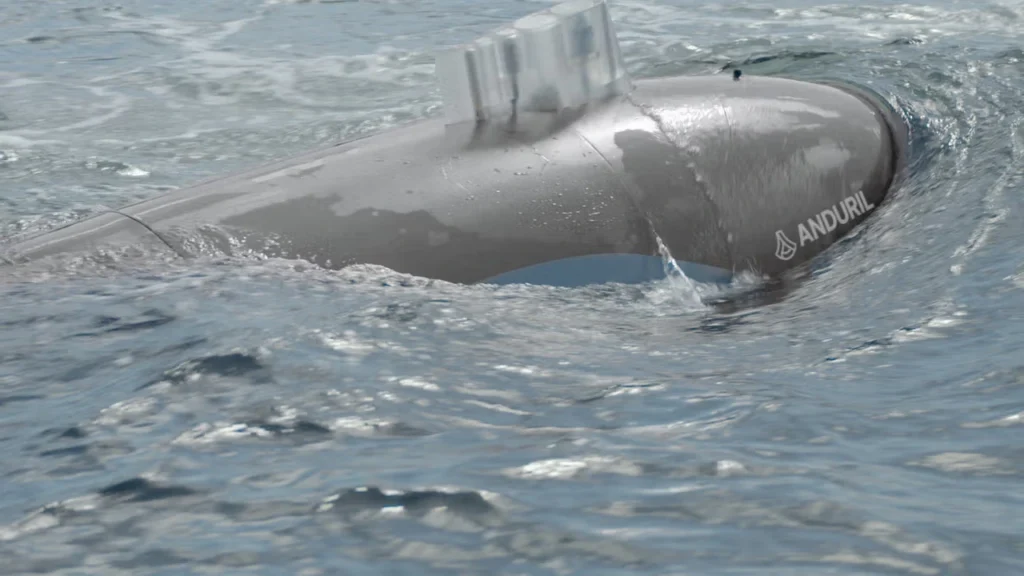
Anduril is currently said to be building around 50 of these subs per year, but the company has already laid out plans to scale production to 200 per year in the near future.
For the Navy, this program is something of a test case to see if they can buy submarines off the shelf, rather than paying a firm to design something for military applications from the ground up.
Aside from the sensor package carried by that specific sub, which was likely related to anti-mining operations in the Strait, it’s not likely that the submarine itself can grant Iran, or its allies, a great deal of highly classified know-how.
For the most part, this sub was designed to use as many off-the-shelf components as possible and 3D-print the rest. So, what’s special about the Dive-LD isn’t any groundbreaking technology onboard, but rather the Navy’s willingness to take something designed deliberately for commercial applications and see if it can fight wars too.
Nevertheless, that doesn’t mean there’s no intel value in recovering a Dive-LD. The drone could certainly point toward American priorities in the medium-submersible space, and there’s a chance that Iran may be able to obtain info on Anduril’s largely-off-board Lattice AI command and control suite.
Sea drone recovery is probably going to be increasingly common in the years ahead, because these kinds of stealthy undersea platforms are meant to stay hidden as their only, line of defense. Once they’ve been discovered, they don’t have the speed to make an escape.
Feature Image: An image appearing to show Anduril’s Dive-LD drone recovered by Iran. (Creative Commons)
Read more from Sandboxx News
- What are Navy SEAL ‘duck’ insertions and which would you prefer?
- 5 of the weirdest traditions of the US military
- America’s massive military advantage nobody talks about: 600+ refueling aircraft
- USS Abraham Lincoln finally returns to port after extremely lengthy deployment – and yes, its rust is normal
- Everything they got wrong about Harrier jets in ‘True Lies’