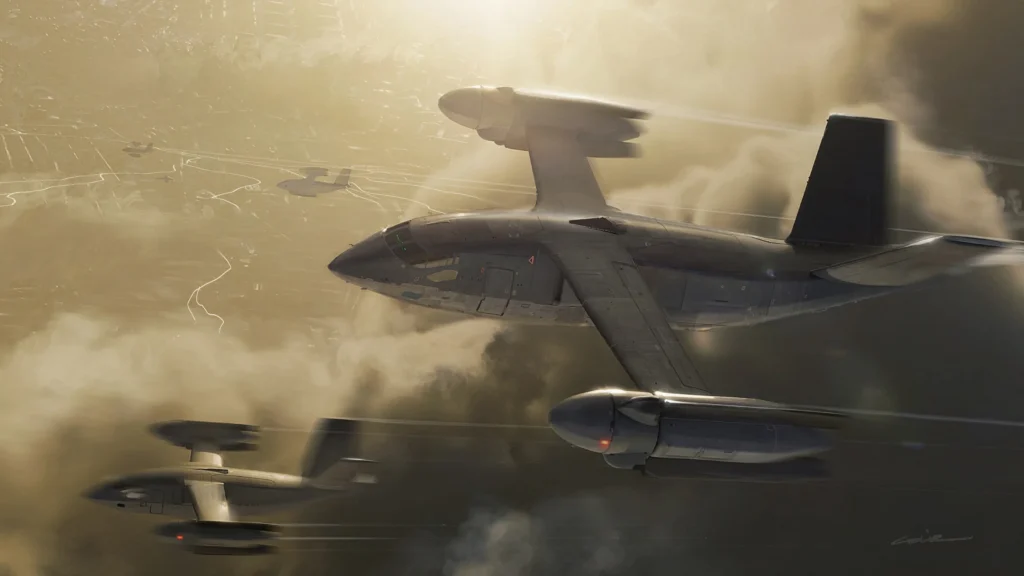
DARPA and the U.S. Special Operations Command (SOCOM) just unveiled their newest X-Plane, the X-76. The aim is to field an aircraft that can hover and land like a helicopter, but fly through the air as fast as a jet. The aircraft’s design, by Bell Textron, has just cleared the critical design review, and construction of the testbed aircraft can now begin.
DARPA, or the Defense Advanced Research Projects Agency, started work on what would become the X-76 back in 2023, and by May 2024, it selected Aurora Flight Sciences and Bell Textron to complete preliminary design work on their respective platforms. In June 2025, Bell Textron’s design was selected to complete design work and move on into flight testing.
Prior to receiving its coveted X-Plane designation, this program matured under the title SPRINT, short for Speed and Runway Independent Technologies.
This new aircraft will operate similarly to existing tilt rotor aircraft. But for horizontal flight, DARPA and SOCOM want much higher top speeds than a rotorcraft could provide. Their stated target at the onset of this effort was for the X-76 to cruise at speeds of 400 to 450 knots, or roughly 460 to 520 miles per hour. That would mean this new aircraft could cruise at well over twice the top speed of today’s UH-60 Black Hawks, well over a hundred miles per hour faster than the V-22 Osprey or the Army’s newer V-280 Valor.
Such speeds would make the X-76 a faster troop carrier than many modern fixed-wing aircraft, like the C-130 Hercules that tops out at around 370 miles per hour. In fact, it would make this vertical landing aircraft faster than the A-10 Thunderbolt II and only slightly slower than a commercial airliner.
What sets the X-76 apart from existing tilt-rotor designs is Bell’s Stop/Fold Rotor System and added jet propulsion. Aircraft like the Osprey and Valor use their large proprotors to allow them to hover like a helicopter and then orient them forward to fly at higher speeds than traditional rotorcraft. The X-76, on the other hand, folds its rotorblades in aerodynamically when transitioning to horizontal flight, and then relies on traditional jet engines for forward thrust.
SOCOM is interested in this technology as a faster means of getting operators into and out of the fight without being reliant on runways. However, Bell says the technology is scalable and could be used for any number of other applications where speed is paramount and runways are sparse, like for combat logistics, combat search and rescue missions, and a whole lot more.
Feature Image: Artist’s rendering of X-76 aircraft. (DARPA)
Read more from Sandboxx News
- A tactical victory on the field does not mean victory against Iran
- What is America’s Tanker Security Program that saw one of its ships getting hit by Iran?
- The Marine Corps is keeping the M27 rifle – and that’s a good thing
- The LUCAS drone is a needed addition to America’s arsenal despite its modest capabilities
- Raytheon to increase production of its SM-6 all-purpose interceptor missile by 300%