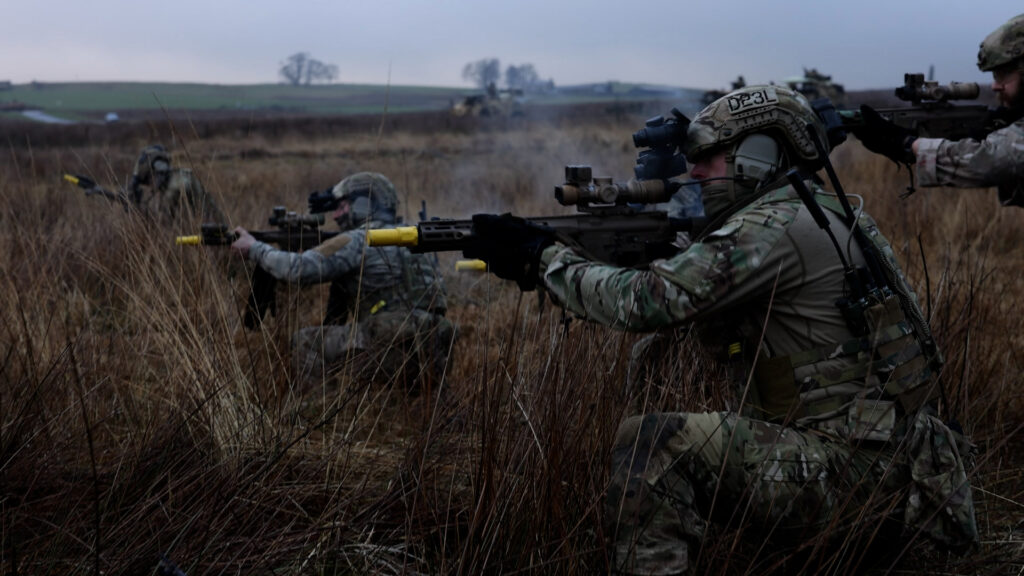
If NATO goes to war, British Royal Marines Commandos and Army Rangers are now ready to be deployed at a moment’s notice.
Over the past few weeks, NATO held a qualification exercise for some of the United Kingdom’s most elite units. The goal was to see whether they are up for the transatlantic alliance’s most demanding mission.
The exercise, named “Hyperion Storm,” took place all over the United Kingdom and tested the Royal Marines’ 42 Commando and British Army Rangers ability to conduct complex special operations. The exercise was the culminating effort after two years of preparation to get the units qualified, the British military said.
As a result of the successful completion Hyperion Storm, from July 1, NATO can rely on a force of around 650 British special operators for rapid deployment in the event of Russian aggression.
42 Commando is now part of the Special Operations Component of NATO’s Allied Reaction Force. The force provides the transatlantic alliance with a rapid-reaction unit that can act as a deterrence or to deal with contingencies or conflicts.
As part of the qualification process, Royal Marine and British Army Rangers conducted a wide range of special operations tasks, including helicopter infiltration and exfiltration, direct action raids, special reconnaissance missions, and night-time ship boarding operations.
On the last day of the exercise, the British troops had to perform a dawn assault. They infiltrated the target area in Chinook helicopters, fought their way from the landing point to the location, and, after clearing it, performed sensitive site exploitation before being exfiltrated.
“This is the culmination of 18 months of exceptionally hard work by forces across all branches of our service, and particularly the junior ranks, of whom I’m extremely proud,” Deputy Commander of the Special Operations Component Command Royal Marines Colonel Phil O’Callaghan said.
The Royal Marines are a 361-year-old unit, but it was during World War II that the unit assumed the special operations mantle and became an elite force. The unit specializes in amphibious and arctic warfare.
Established in 2021, British Army Rangers are the newest special operations unit in the British military. They specialize in unconventional warfare and foreign internal defense.
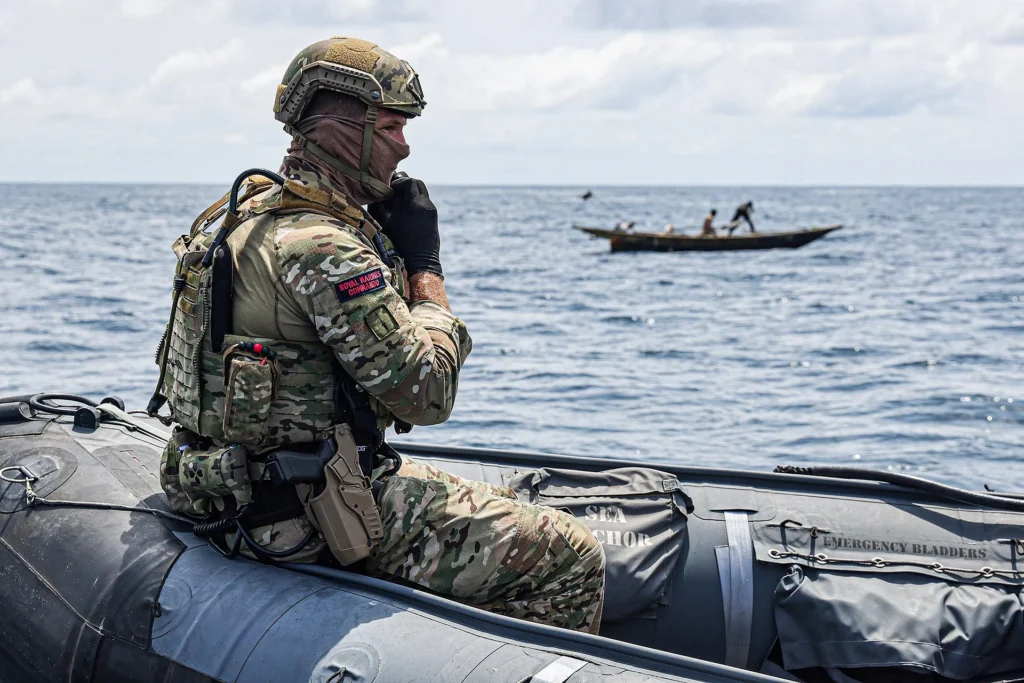
O’Callaghan described the scenarios the British troops could now participate under NATO.
“So, there’s probably three broad categories you can wrap it up under. One is military assistance, where we, for example, would go into a country to assist them in the development of their indigenous capability or work with partners,” he said.
This mission set can have a dual use: foreign internal defense and unconventional warfare. In many ways, these two are the opposite sides of the same coin.
Foreign internal defense is when a special operations element deploys into a country and assists the friendly local government with training its forces. U.S. Army Special Forces A-Teams, for example, spent decades training and working with the Afghan National Army.
Unconventional warfare, on the other hand, is when a special operations element deploys to a hostile country, links up with the guerrillas in opposition, and trains them to topple the government. When the first Green Beret A-Teams and CIA paramilitary officers infiltrated Afghanistan following the September 11 terrorist attacks, linked up with the Northern Alliance fighters, and overthrew the Taliban government, they were conducting unconventional warfare.
“One is special reconnaissance, where we might look at surveillance activities or even post-strike assessments to gain information for Nato [sic] and our alliance partners,” the senior Royal Marines officer added.
“And then also, subject to the right permissions, we can conduct direct actions, such as raids or attacks onto targets, if the military necessity judges that a requirement,” O’Callaghan concluded.
Direct action might be the most attention-grabbing aspect of special operations, but it is only one mission set in a toolbox full of versatile skill sets.
From July 1, the U.K. will lead NATO’s Special Operations Capability and the units involved will be on stand-by to deploy until mid-2027.
Feature Image: British commandos during Hyperion Storm. (Forcesnews via British military)
Read more from Sandboxx News
- Second US Navy carrier strike group now heading towards Iran
- US military operations heat up once again in strategically important east Africa
- Breaking down the SERE school myths: How accurate are they?
- Ukrainian F-16 shoots down Russian drone with its onboard cannon – and why this is an incredible feat
- Defending the big ship: How America protects its aircraft carriers