One of the Air Force’s most important new weapons programs is the Family of Affordable Mass Munitions, or FAMM, which aims to provide the branch with thousands of low-cost missiles to fulfill its needs.
According to the Air Force’s 2027 budget request, the branch aims to spend $12 billion over the next five years to purchase a whopping 28,000 air-launched cruise missiles that offer between 250 and 500 nautical miles in range, or roughly 287 to 575 statute miles.
These weapons will come with standard lugs to be carried and launched by conventional combat aircraft. They are also being designed to be launched vertically from the Air Force’s new Dragon Cart palletized launch system, which allows cargo aircraft, like the C-17, to fire a multitude of missiles.
Dragon Carts were initially designed around Lockheed Martin’s high-end JASSM line of air-launched cruise missiles. However, there is limited capacity to produce the high-capability, high-cost systems of the JASSM line, which also include the JASSM-ER and Long Range Anti-Ship Missile (LRASM).
In 2026, for instance, the Air Force intends to purchase just 389 JASSMs to the tune of around $1 billion and just 118 LRASMs for another $431.6 million. That means an entire year’s worth of production and nearly $1.5 billion in munitions could be depleted in just about 11 Dragon Cart sorties using the C-17.
And that’s where FAMM’s low-cost cruise missiles come in to provide the Air Force with the number of munitions it will require.
Two of the biggest names in the FAMM effort are Lockheed Martin, with its Common Multi-Mission Truck, or CMMT (pronounced COMET) line of low-cost cruise missiles, and Anduril with its Barracuda-M500 line.
The CMMT and Barracuda-M500 missiles are expected to be able to carry 100-pound high-explosive warheads to targets some 500 nautical miles out, or roughly 575 miles.
Sandboxx News recently spoke to Anduril and Lockheed Martin about these weapons.
Both companies made it clear that they didn’t perceive each other as a competitor in this space. This is because the production capacity the Air Force is looking for exceeds that of any single supplier – which also means that likely the U.S. will continue to stockpile these munitions for some time to come.
Several other notable low-cost cruise missile competitors have also surfaced, including the Black Arrow from Leidos, the Ragnarok from Kratos, and a new modular iteration of the ADM-160 MALD called the MALD-V that can carry warheads instead of electronic warfare systems.
And then, there is Boeing’s new JDAM-LR, which effectively turn low-cost JDAMs into turbojet-powered cruise missiles with ranges in excess of 345 miles.
Purchasing these FAMM weapons will make it possible to combine pallets of low-cost cruise missiles with higher-end JASSM-ERs and LRASMs.
The less expensive weapons will help saturate enemy airspace and strike stationary targets while the stealthy JASSM-ERs and LRASMs will hunt for more important prey amid the turmoil.
The Air Force aims to start ramping up cruise missile production in 2027 with the purchase of just 1,000 new missiles. This will be followed, in 2028, when production lines reach full steam, by a sharp increase with 5,920 weapons slated for purchase. By 2031, that figure will stand at 7,990 missiles per year.
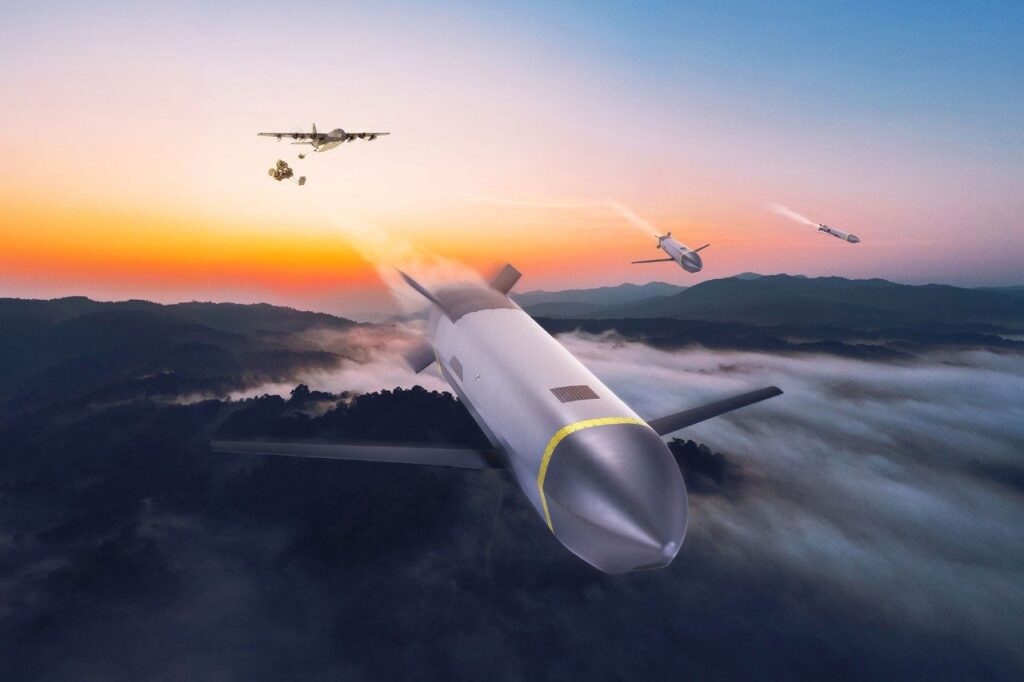
Feature Image: Artist’s concept of the CMMT missile. (Lockheed Martin)
Read more from Sandboxx News
- What will the aircraft carrier’s future look like and can another platform replace the ocean’s biggest warship?
- Air Force is looking to field a replacement for the legendary B-52 bomber
- Canadian military is getting a new rifle – and Colt was again chosen to produce it
- Air Force’s Rapid Dragon, which turns cargo aircraft into missile launchers, is finally going live
- Recon Marines will need to swim more and hide from drones in training shakeup