Last year, retired Marine Corps Lt. Gen. Robert Schmidle developed a computer-based war game that proposed a plausible real-world crisis – an “event” by China in the Taiwan straits – and challenged a group of national security practitioners to respond to it with the option of teaming with AI tools in an effort to better understand how the teaming relationship should work.
Schmidle, a former head of Marine Corps aviation and deputy commander of U.S. Cyber Command who’s now a professor of practice at Arizona State University and senior fellow at its Center on the Future of War, told Sandboxx News in an interview that he was surprised at how readily participants used AI as a resource.
“What surprised me was, when we put a significant time constraint on the players, that rather than go with their quote gut instinct, they tended to rely more on the AI than I thought they would,” Schmidle said. “I’m still digging into that … I didn’t think that that would be the case, and I thought that it would be that they would be more likely to lean on their own, quote, human gut instincts in some of these cases.”
Equally surprising, he said, was that, in some cases, AI appeared to hold the human players back from acting as aggressively or creatively as they chose – at times, appearing to be “dragging its feet” in execution.
“The red team that were role-playing the Chinese were … trying to conduct certain operations, and the AI was pushing back on them,” Schmidle said. “The developers had, without even thinking about it and knowing it, unconsciously created guardrails that reflected what they thought would be the way that these operations would be conducted by Americans … When I talked to the guys who had been writing the code, they had absolutely no idea that that happened. So there’s something there that I think is worthy of some more exploration.”
It’s possible, he suggested, that AI tool developers may need to think more fully about how the enemy operates, and evaluate some of their hidden biases.
“The operators were convinced that the Chinese would not be beholden to those kinds of guardrails, and they’re right,” Schmidle said. “But yet, they had somehow crept into the AI development.”

But there are also other pieces of decision-making, including how AI teaming takes place on the battlefield but also extending to other components of how the human mind interacts with combat, that he’d like to explore more deeply.
“It’s an embodied human that makes a decision, and that is based on their embodied context,” Schmidle told Sandboxx News. “If there’s people stranded in a lifeboat in freezing cold water, you’re likely to make different decisions than you would if it was on a nice sunny day and you were sitting on the back of a catamaran. The brain is the same brain, but it’s affected by those outside things.”
Schmidle said he’s currently seeking funding for a new war game that will further examine “the space in which we could use cognitive activities to deter an adversary,” or cognitive deterrence.
He wants to divide players into three populations: humans assisted by AI tools; humans with no AI help; and AI agents acting on their own. The goal, he said, would be to gather data on the speed and quality of the decisions made by each of the three groups.
In an academic paper published in August, Schmidle emphasizes the importance of seeing the brain as a battlespace, and taking advantage of AI to gather a greater range of information on human behavior.
“Artificial intelligence systems can analyze big datasets to identify behavioral patterns, cognitive/emotional tendencies, preferences, vulnerabilities and volatilities, and do so in ways that enable individual-to-group and group-to-individual comparisons and norming,” he and co-author Dr. James Giordano wrote. “For example, machine learning systems are capable of integrating biological, psychological, social, cultural, economic, and informational variables simultaneously to identify patterns, correlations, and predictive relationships within datasets.”
Related: Navy wants its own AI-piloted drone fighters to put on aircraft carriers
Among the recommendations in that paper are calls for the creation of a Joint Cognitive Security and Neurostrategic Center to integrate expertise on cognitive warfare, and the establishment of formal human-AI cognitive teaming programs “to develop technologies that enhance decision-making while preserving human judgment and ethical oversight.”
The authors also call for development of new military training and education in cognitive resilience to strengthen troops against adversaries wielding their own cognitive warfare tools and dealing in manipulation, coercion and misinformation.
Schmidle stressed that warfare continues, at its heart, to be about humans and their behavior. But, he said, machines may help American warfighters to prosecute that fight better, particularly in contemporary wars, including Iran, in which understanding the adversary enough to reach an end state has been an elusive goal.
“We’ve not understood the adversary to the depth that’s necessary for us to successfully use warfare as a tool of statecraft,” he said.
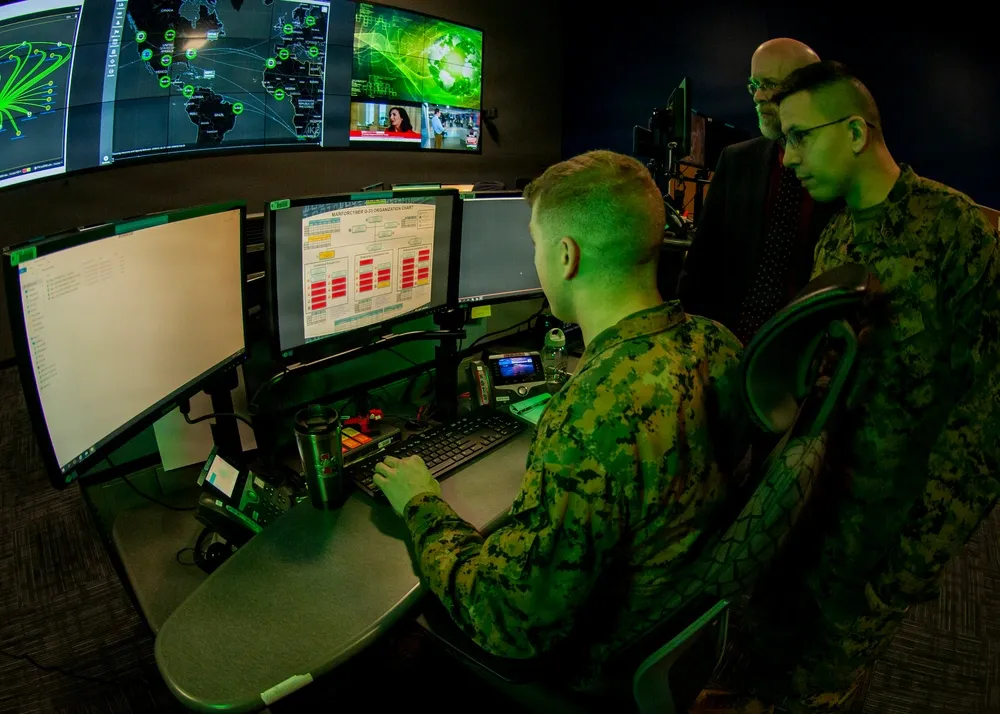
Feature Image: Marines with Marine Corps Forces Cyberspace Command pose for photos in the cyber operations center at Lasswell Hall aboard Fort Meade, Maryland, Feb. 5, 2020. (Photo by Master Sgt. Jacob Osborne)