Over the last three decades, the Marine Corps, Navy and Air Force have all operated a version of the V-22 Osprey tiltrotor – a hybrid aircraft that can take off and land like a helicopter and fly like a plane. But the Army has largely been left out of the tiltrotor action. That is, until right now.
This spring, the service announced that the aircraft to fill its Future Long Range Assault Aircraft mission would be the MV-75, a sleek and capable platform based on Bell’s V-280 Valor prototype – and named in honor of the Army’s founding year, 1775. A prototype of the MV-75 does not yet exist, and fielding is not expected to begin until 2030.
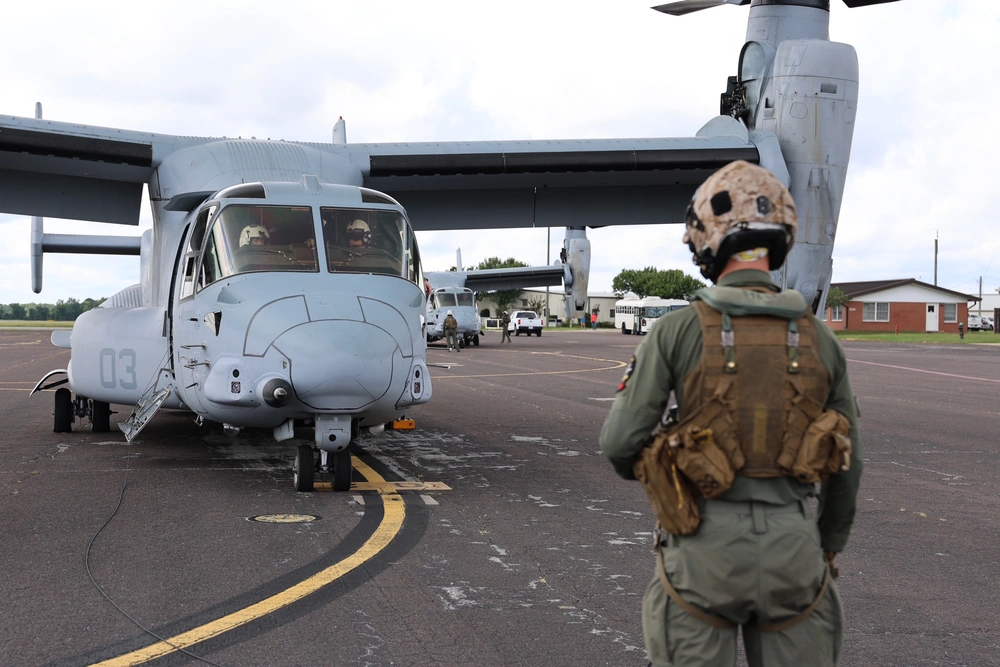
But well before then, the Army needs to ready its pilots to operate the new platform, and that groundwork is already beginning. In July, two Marine Corps MV-22 Ospreys from Marine Corps Air Station New River, NC, landed at Fort Rucker, Alaska, allowing a small cadre of aviation experts to experience familiarization flights on the platform.
“Those flights were a ‘target of opportunity,'” according to Chief Warrant Officer 3 Joshua Baker, training developer in the Directorate of Training and Doctrine. In a news release, he explained that the MV-22s had been onsite for a separate training event. However, the Army is taking a number of deliberate steps to ready the force for tiltrotors.
The Future Long Range Assault Aircraft (FLRAA) program was initiated by the service in 2019 to complement and eventually replace the capabilities of the UH-60 Black Hawk. And the service is in a hurry to integrate the MV-75 into the ranks. In May, Flight Global reported that the Army planned to leapfrog some steps in the evaluation and design phase to accelerate delivery of the aircraft to the force.
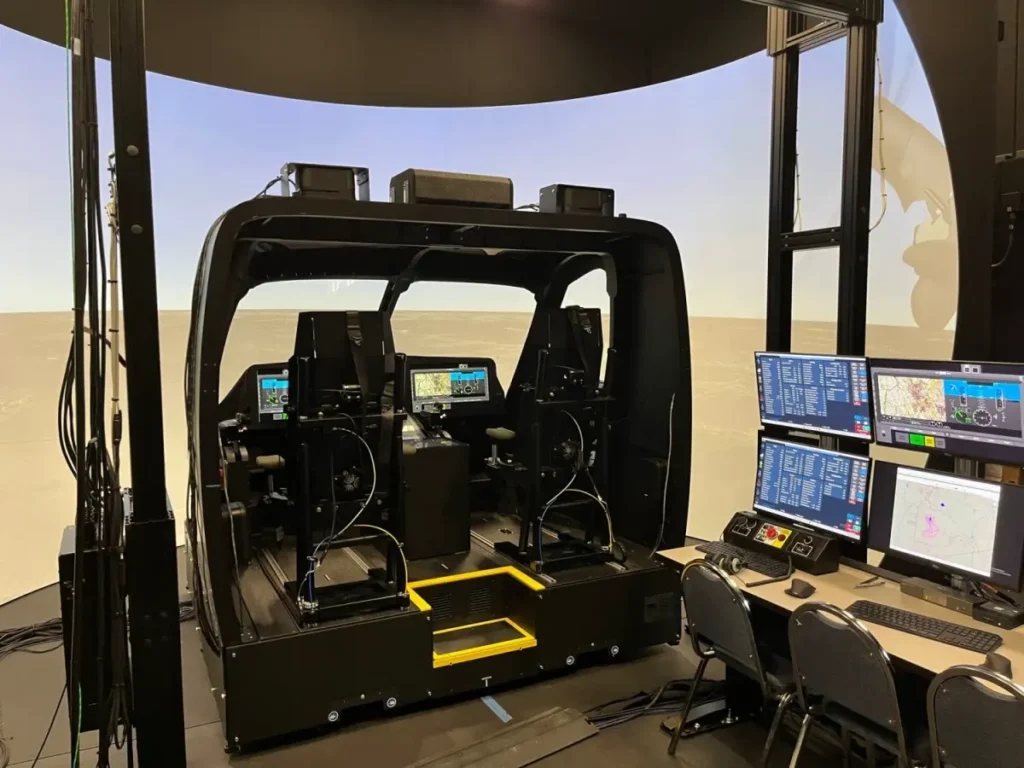
The Army in June accepted the first MV-75 Future Long Range Assault Aircraft virtual prototypes, built inside a shipping container, at Rucker and at Redstone Arsenal, a five-hour drive north. Familiarization flights were paired with ground school and 60 hours of simulation training on-site at New River, according to service releases.
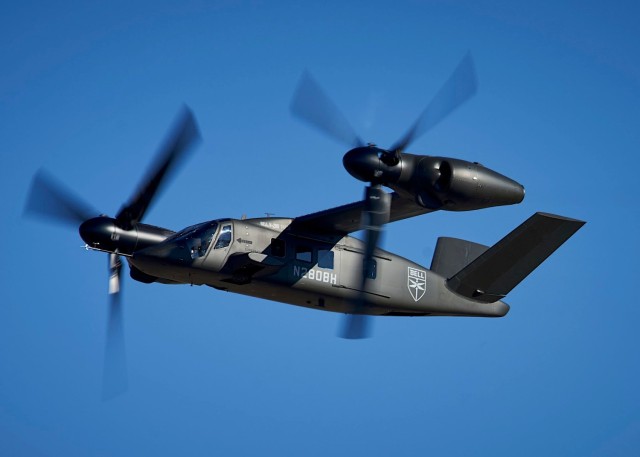
One of the participants in the ground and simulator training and familiarization flights was Chief Warrant Officer 5 Brian McKnight, another training developer at DOTD. A Black Hawk helicopter pilot by training with more than 4,000 hours in the cockpit, McKnight told Sandboxx News he was impressed with how quickly the Osprey converted from the helicopter-like vertical takeoff and landing (VTOL) mode to airplane mode.
“We transitioned from helicopter mode to aiplane more in less than two miles, and we were already doing over 200 knots,” he said. “So that was very impressive, especially the G-forces that it puts on the body as it accelerates. You don’t get that acceleration in a helicopter.”
The Army envisions using the MV-75 for “long-range, large scale air assault,” McKnight said, and a version of the platform will also be used for rapid medevac missions.
“We’ve done some exercises to where we can move X amount of troops twice as fast and twice as far as we can with a standard combat aviation brigade of Chinooks and Black Hawks. So that’s where we’re really going to see the benefit,” he told Sandboxx News.
A major anticipated learning curve for Army aviators, he said, would be learning how to exploit the tiltrotor’s capabilities, and particularly the fact that the MV-75 will be flying like a fixed-wing airplane up to 80% of the time.
Related: Army’s future helicopters could be more autonomous and launch their own drones
At New River, McKnight said, he was able to meet seasoned aviators who recalled when the Marine Corps made the switch from rotary-wing – with platforms like the CH-46 “Phrog” Sea Knight – to the Osprey.
“They noticed through the first five to 10 years that they were flying it like a CH-46, that they were essentially in helicopter mode and not airplane mode, when it’s really designed to be in airplane mode the majority of the time,” he said. “So it took a lot of growing for them and experience to develop how they really fly it now. And that was one of the things they told us to look for – to make sure that we were training our aviators to fly as it”s [intended] it be, not as a traditional helicopter.”
While most of the Army’s aviation fleet is rotary-wing aircraft, it does have some fixed-wing planes, such as the twin-turboprop C-12 Huron.
“We really haven’t even gotten to the step of what pilots are going to select,” McKnight said. “I do assume that a lot of those pilots are going to be rotary-wing, and probably a mix of fixed-wing.”
The mixed-mode flight capability and the range and efficiency, he said will “change how we fight, and also it’s gonna change how we can support the troops on the battlefield.”
The Army will also have the benefit of building on the Marines’ V-22 training protocols, even though the MV-75 won’t be an identical aircraft. McKnight said he and other training developers were beginning to evaluate what they’d learned from the Marines about basic flight maneuvers and what insights would transfer. They are also beginning to develop proficiency in more advanced maneuvers, including tactical takeoffs and landings.
All this advance work will prepare the Army for the arrival of a first MV-75 prototype from Bell, currently expected at the end of 2026.
Feature Image: Army Aviators participate in a familiarization flight of the MV-22 Osprey with members of the Marine Corps Marine Medium Tiltrotor Training Squadron 204 (VMMT-204) at Marine Corps Air Station New River at Fort Rucker on July 24. (Photo by Leslie Herlick/Aviation Center of Excellence)
Read more from Sandboxx News
- What could “security guarantees” for Ukraine look like?
- What movies and videogames get wrong about weapons and military tech
- Frosted misery: A Navy SEAL in SERE School
- Let’s rank America’s fighter jets (and some of its other planes) based on their top speed
- SOCOM has now included AI in its top-tech wish list