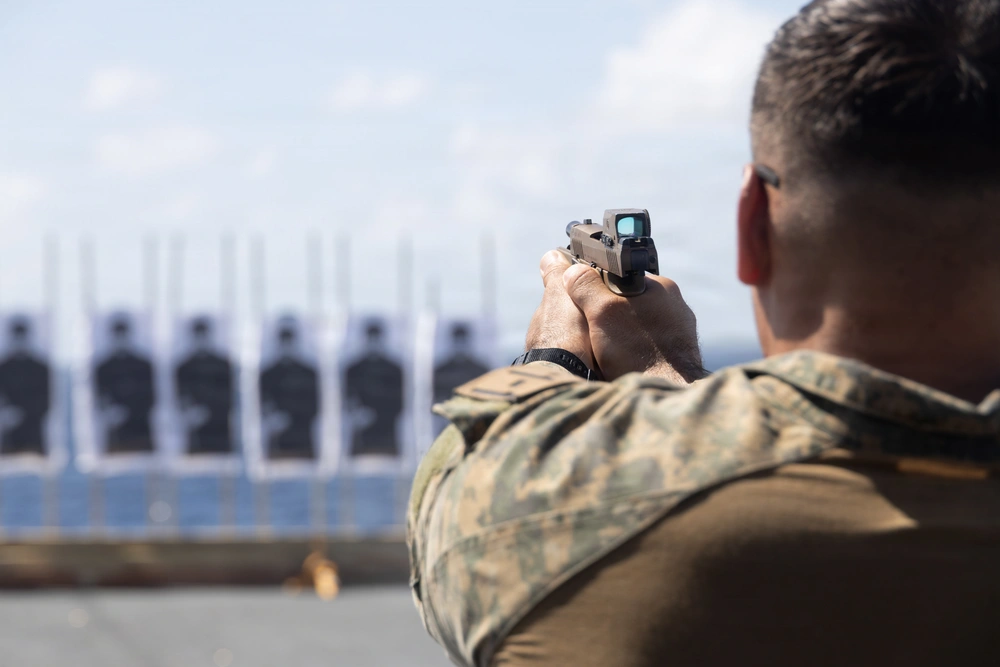
The adoption of the SIG M18 by the Marine Corps in 2019 marked the first time that the branch’s service pistol came with the option to attach a micro red dot. Marines are now taking advantage of that capability. Kind of.
A Marine Administrative Message, or MARADMIN, was released in March permitting Marines to use red dots in their annual handgun qualification. The red dot must be the SIG ROMEO M17 optic, however, and it must be issued by the Marines’ unit. How many units will purchase and issue red dots for handguns remains to be seen.
Historically, the Marine Corps has been a fairly progressive branch regarding the use of optics. Infantrymen long fielded the famed ACOG and have now transitioned to the 1-8X VCOG low-powered variable optic. Machine guns and grenade launchers also received optics, but will Marine leaders see the need for red dots on handguns?
Red dots on handguns – an inevitability?
Handguns are limited-issue and limited-use items in the Marine Corps. They are often reserved for platoon sergeants and officers, though they can be issued to other troops depending on their roles. As a machine gunner, I carried an M9, but I was one of the very few junior enlisted members and one of the few machine gunners to carry one.
Outside of qualifying and training, I never used my handgun. I only saw a handgun drawn once in Afghanistan, and it was never fired.
If a unit has a tight budget, it might be difficult to justify the expense of adding red dots to handguns. However, one area where the red dot will likely enter mainstream Corps service is with MPs, who carry handguns daily.
Marine Corps Special Operations and Recon will also likely field red dots due to the nature of their jobs. Historically, these units have already used optics, specifically on Glock pistols.
Overall, I believe it is inevitable that red dots will eventually become standard-issue items, as their advantages are apparent. While it remains unclear how long that transition will take, police forces and several militaries worldwide are already leaning in that direction.
Why use a red dot

Without a third point of contact and with a short sight radius, handguns can be challenging to master. A red dot removes some of that difficulty. Essentially, a red dot allows you to shoot faster; shoot farther; and shoot straighter.
In terms of speed, a standard handgun has a rear sight consisting of two posts with an empty middle slot. The front sight is a single post that, when properly aligned, sits between the rear sights. Proper alignment requires the shooter to focus across three different planes. You must place the front sight between the rear sights and align them while simultaneously focusing on a potential threat.
A red dot simplifies the above process: With a red dot, you focus on the target, and the dot confirms your aim. This allows you to acquire a sight picture faster while remaining threat-focused, leading to quicker engagements.
Red dots are bright and easy to see. Since you aren’t struggling to establish perfect alignment, you simply place the dot where you want the round to go. This makes it easier to shoot accurately, especially under pressure.
Since the red dot is much smaller than a traditional front sight, it obscures less of the target. It is difficult to hit what you cannot see, and the smaller profile of the red dot makes it easier to shoot at greater distances with better accuracy.
The ROMEO M17 optic
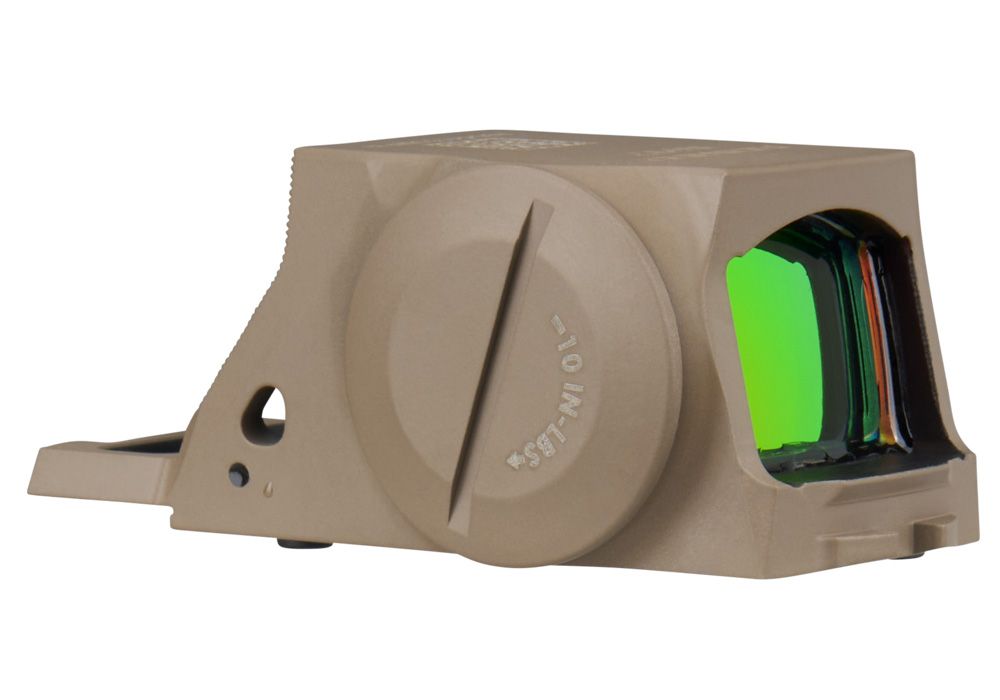
The ROMEO M17, which was approved for use in annual handgun qualification by the Corps, is an enclosed-emitter optic meaning the source that projects the reticle onto the glass is not exposed to the elements, making the design weather-proof. Enclosed emitters are quickly becoming the standard for law enforcement and military forces due to their increased reliability.
Further, the optic offers settings compatible with night vision so it can operate fine in low-light environments.
It also features SIG’s MOTAC (Motion Activated Illumination) technology allowing it to shut itself off when it’s not moved and power itself back on instantly when it is, thus preserving battery life while ensuring it is always ready. Additionally, it uses MAGNETAC, which automatically shuts the optic off when used with compatible holsters and turns it on immediately upon being drawn.
Overall, the ROMEO appears to be an impressive, high-quality dot with a lot to offer and has already received its National Stock Number.
This marks the first step in the Marine Corps’ acceptance of red dots on pistols. There is likely a long road ahead before every Marine is fielding one, but allowing the use of an optic for handgun qualification is a significant step forward.
Feature Image: A U.S. Marine with Maritime Special Purpose Force, 22nd Marine Expeditionary Unit (Special Operations Capable), fires an M18 pistol during a qualification range aboard San Antonio-class amphibious transport dock USS Fort Lauderdale (LPD 28), while underway in the Caribbean Sea, Feb. 22, 2026. (Photo by Gunnery Sgt. Brett Norman/22nd Marine Expeditionary Unit)
Read more from Sandboxx News
- The little-known Pentagon agency behind the rescue of the F-15 crew in Iran
- The C-17 Globemaster is the Air Force’s unsung hero
- How the US saved the crew of a downed F-15 deep within Iranian territory
- YFQ-42 AI-enabled drone crashes for the first time during testing
- North Korea’s Type 88-2 AK rifle is horribly bad