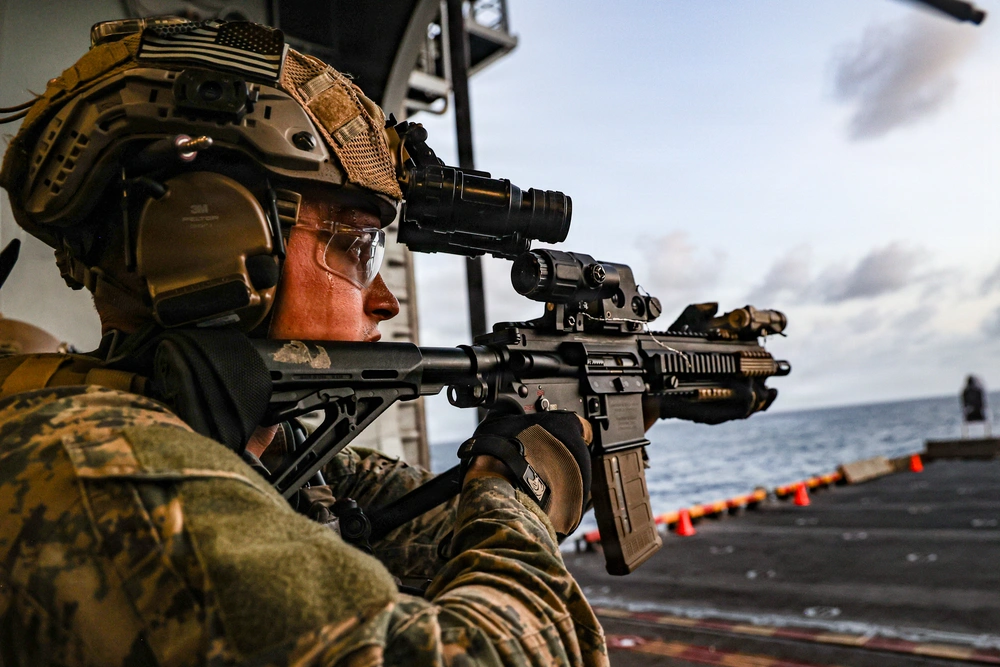
Task & Purpose recently reported that the Marine Corps is keeping the M27 Infantry Automatic Rifle for the moment and has no plans to swap to the Army’s new M7 rifle series.
“The Marine Corps will retain the M27 for our close combat formations as it best aligns with our unique service requirements, amphibious doctrinal employment of weapons, and distinct modernization priorities, while ensuring seamless interoperability across the Joint force and with coalition partners,” a Corps spokesperson told Task & Purpose.
And the Corps is making the right decision in sticking with the M27.
Half baked from the start
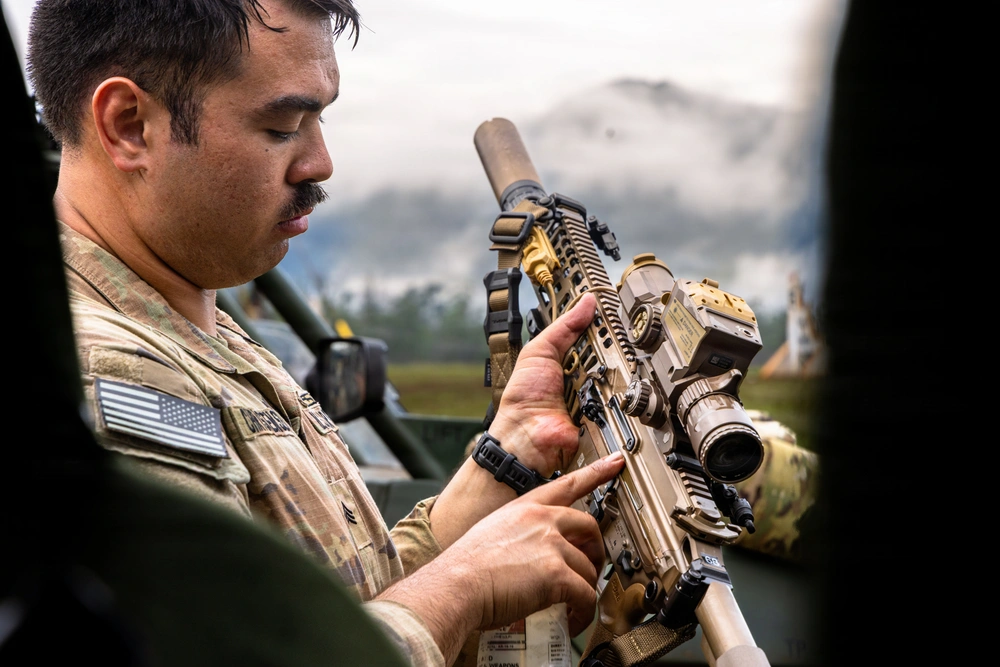
The goal of the M7 was to provide troops with increased range, accuracy, and lethality. The M7 uses a 6.8x51mm round that’s moving at a little over 3,000 feet per second. The M7 would be paired with a fire-control system which is essentially a smart scope that incorporates technology, like a laser rangefinder, to make troops more accurate.
For an average soldier to be able to accurately hit targets at 600 yards they need the fire-control unit. Shots at 600 yards are easy to make at the range, but difficult on a battlefield filled with moving targets, dust, debris, and return fire – even with an advanced smart scope.
However, the war in Ukraine has shown that most infantry combat takes place within about 120 yards – and that’s also where traditional assault rifles excel. The infantry’s job has always been the last 100 yards, and at that range, the M7 seems more like a detriment.
Additionally, the weapon’s fire-control unit has a significant flaw: its rangefinder can be easily detected by equipment small enough to fit on a helmet and potentially reveal the shooter’s – and therefore, his squad’s –position.
No smart optic, no point
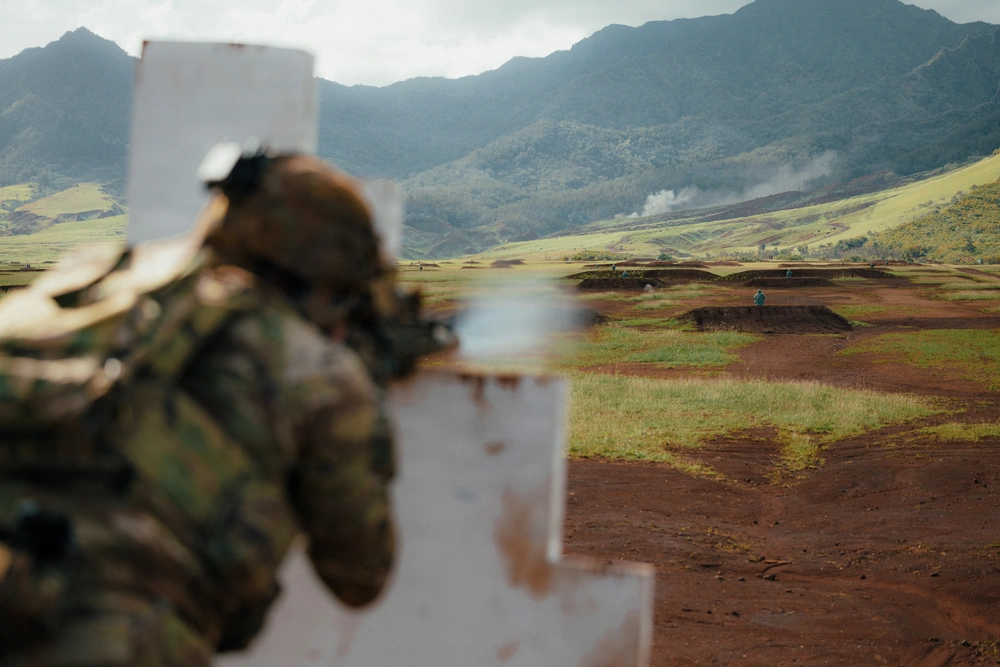
If the U.S. faces a near-peer adversary that uses laser detection, the Big Army’s best move would be to remove the fire-control units of the M7s from the line and replace them with regular optics. In that case, however, we have to ask, what would the point of the M7 even be?
Its new rifle round will go far and hit hard, but it is doubtful that the average infantry Soldier will be able to make use of that range without the fancy optic. And even a skilled shooter would only benefit from it under optimum conditions.
Without the smart scope, we would have Soldiers carrying the heavy M7 rifle with its heavy ammo, but without being able to use the weapon as the Army theoretically intended.
A step back in weight and ammo
For the M7 the Army required a heavier round that would reach high velocities from a short barrel. Yet, this creates a lot of wear and tear to the barrels. This, in turn, creates a need for both training and duty ammo to keep the barrels from burning out too fast. As a result, logistics are more stressed and ammo is at an increased risk for case ruptures – something you don’t want to happen in the middle of combat. Further, the M7’s ammo is more expensive and currently slower to produce. Whereas, the Marine Corps’ 5.56 has been around forever and is easily obtainable.
In the 1960s, the M16 replaced the M14, which was a truly awful rifle. Choosing the M16 was the result of decades of tests on infantry small-arms effectiveness following World War II. The SAWS test, the SPIW, SALVO, and more, all pointed to a lightweight, intermediate-cartridge rifle for maximum effectiveness.
The M16 offered a lighter rifle and, more importantly, lighter ammunition which meant that a soldier could carry more of it. Most shots fired in combat are intended to suppress the enemy, allowing troops to maneuver, close the distance, and finish the fight with close-range combat and grenades. Having more ammo and a lighter rifle made it easier to close that distance while suppressing.
But the M7 weighs about as much as an unloaded SAW: that’s 15 pounds of gun, optic, and suppressor, plus lights, lasers, and other accessories. At the same time, the combat load has been reduced from 210 rounds per rifleman to 140 rounds with the M7. We are stepping back to the flaws of the M14 regarding weight.
I don’t think SIG made a bad rifle with the M7: they made the best rifle they could with the Army’s requirements. But keeping the M27 and the 5.56 cartridge seems to be the logical move for the Marine Corps. The rifle and the round are still doing what the Marine Corps needs, while long-range fires are provided by machine guns.
The M7 doesn’t seem like the step forward the Army hoped for, and I’m doubtful it will meet its goals.
Editor’s Note: This article has been updated to now correctly state that the M16, and not the M4, replaced the M14.
Feature Image: A U.S. Marine with Maritime Special Purpose Force, 22nd Marine Expeditionary Unit (Special Operations Capable) sights in on an M27 Infantry Automatic Rifle during a live-fire range aboard Wasp-class amphibious assault ship USS Iwo Jima (LHD 7), while underway in the Caribbean Sea, Feb. 4, 2026. (Photo by Cpl. Emily Hazelbaker/22nd Marine Expeditioary Unit)
Read more from Sandboxx News
- The LUCAS drone is a needed addition to America’s arsenal despite its modest capabilities
- Raytheon to increase production of its SM-6 all-purpose interceptor missile by 300%
- German military goes against tradition and chooses a non-German weapon as its new handgun
- US embraces ‘Shanzhai’ with copycat Iranian drone
- American submarine sinks Iranian frigate and achieves Navy’s first torpedo kill since WWII