Last month, Lockheed Martin announced an agreement with the Pentagon to increase THAAD production by 316% from 96 to 400 interceptors per year over the next seven years.
Standing for Terminal High Altitude Air Defense, THAAD provides a ballistic missile interception umbrella that reaches outside the atmosphere and encompasses a wider area than other interceptors, like the Patriot. The system can shoot down short, medium, and intermediate-range ballistic missiles during their terminal phase.
Each THAAD battery is operated by 90 troops with six truck-mounted launchers, each of which carries eight interceptors for a total of 48. These interceptors are powered by a thrust-vectoring single-stage solid rocket motor, and for exo-atmospheric intercepts, the kill vehicle itself comes equipped with a liquid DACS (Divert and Attitude Control System).
DACS is developed by Boeing and allows for precise thrust control during the terminal phase of the intercept, using a focal-plane array infrared seeker to close with targets traveling at speeds of up to 17,000 miles per hour (which would equate to around Mach 22 inside the atmosphere).
These interceptors have a publicly disclosed capability of reaching targets that are 93 miles, or 150 kilometers, above the earth’s surface – some 31 miles above the generally recognized barrier into space – at ranges of 125 miles, or about 200 kilometers, from the launcher.
As a highly specialized and incredibly capable system, there are only 10 (or maybe 11) active THAAD batteries in the world today, according to Lockheed Martin, seven of which are operated by the United States. However, a Congressional Research Service report from September 2025 says that the United States currently operates eight THAAD batteries. That disparity seems to come down to the delivery of a THAAD “Minimum Engagement Package (MEP)” in June of last year. This package included three launchers and a fire control unit, or roughly half of a complete THAAD battery, with the rest of the components slated for delivery in the months after.
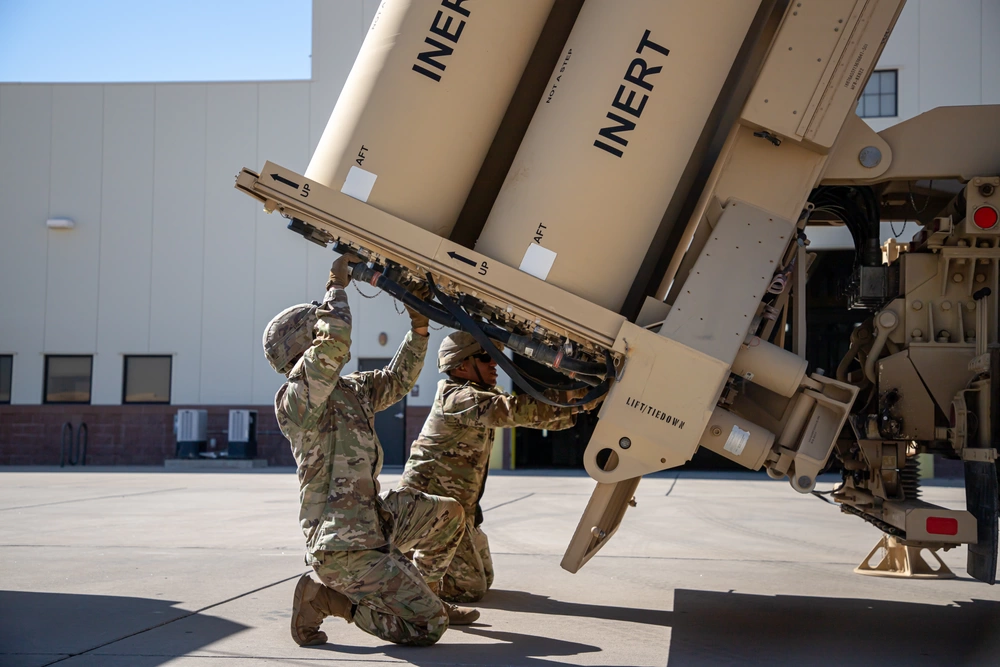
THAADs are rare, exquisite assets, and as such, interceptor production has remained relatively modest, at just 96 per year to date. And while the number of countries known to build and operate ballistic missiles has not increased considerably over recent decades, the cost of fielding such missiles has continued to come down, therefore increasing their availability. Further, some of the extra missiles find their way into the hands of non-state actors, like the Iranian-backed Houthis and more. These factors have made the need for increased THAAD interceptor production more pressing, but until recently, that market signal had not resulted in expedited deliveries.
The U.S. does not disclose the status of its total THAAD interceptor stockpile, but a December 2025 report that analyzed comptroller procurement documents found that America’s Missile Defense Agency currently has a 100-interceptor backlog. The last interceptors were delivered to the U.S. in 2023 and another delivery is not expected until 2027, despite Lockheed’s factory continuing to produce these systems, according to the report. This suggests that the production of recent years has been funneled toward THAAD’s two foreign operators, Saudi Arabia and the U.A.E., but Lockheed hasn’t formally acknowledged that.
At the newly announced production rate, it would take Lockheed Martin just about three months to clear that 100-interceptor backlog; whereas at current production levels, it would take the company more than a year.
Prior to American THAADs being used in June 2025 to help defend Israel against Iranian ballistic missiles, ther country’s THAAD interceptor stockpile was estimated to be at 534, enough to fully equip all eight THAAD batteries and leave 150 spares for reloads. In June, however, the U.S. Army reportedly expended somewhere between 100 and 250 interceptors, which, at best, would be enough to erase more than 66% of America’s spare inventory, and at worst, could result in American having too few interceptors on hand to fully arm all of its THAAD launchers.
Feature Image: A Terminal High Altitude Area Defense (THAAD) interceptor is launched from the Pacific Spaceport Complex Alaska in Kodiak, Alaska, during Flight Experiment THAAD (FET)-01 on July 30, 2017 (EDT). During the test, the THAAD weapon system successfully intercepted an air-launched, medium-range ballistic missile target. (Photo by Leah Garton/Missile Defense Agency)
Read more from Sandboxx News
- Army unveils its first new offensive hand grenade in nearly 60 years
- American and Israeli forces have struck more than 6,400 targets across Iran
- How have four years of war impacted the Russian military
- DARPA and SOCOM unveil X-76, their newest X-Plane designed to transport operators much faster than before
- A tactical victory on the field does not mean victory against Iran