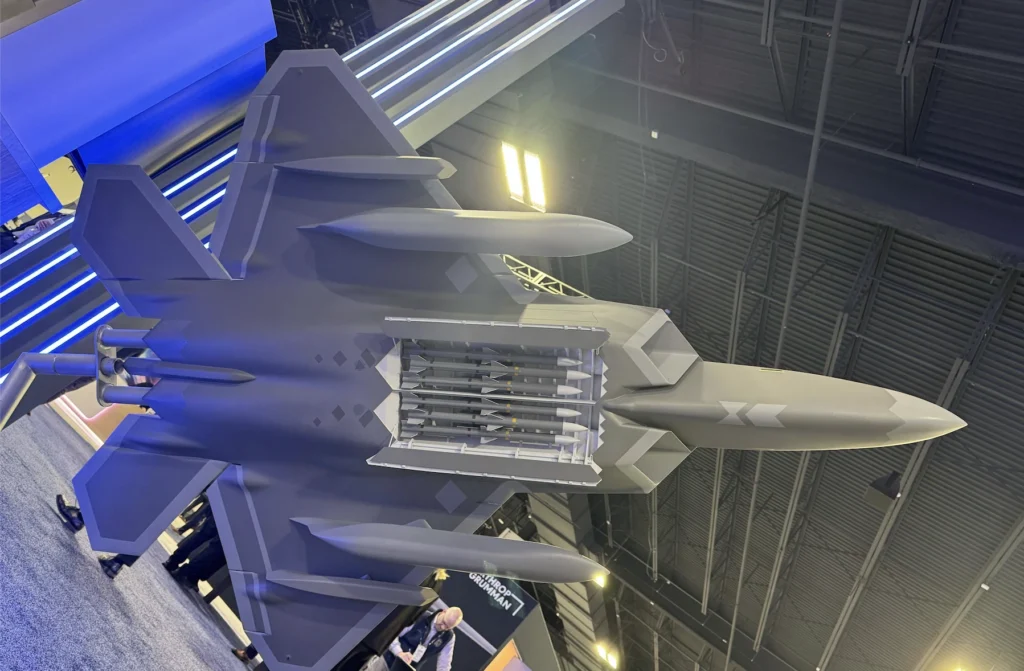
DENVER, Colorado – Lockheed Martin’s stealthy new fuel tanks, meant to be carried by the F-22 Raptor, are already in production and are much more capable than previously believed.
The F-22 Raptor is America’s premier air superiority fighter. An $11 billion upgrade program is now underway meant to reinvigorate the aging Raptor fleet that has now been flying for over two decades. A significant part of this effort includes the Low Drag Tank and Pylon program, which, for some time now, has been described as a stealthy replacement for the 600-gallon drop tanks carried by Raptors on ferry flights to extend their range. These tanks, and the underwing pylons they’re attached to, substantially compromise the fighter’s stealth profile and maneuverability. As a result, they can’t be used in the fight. If, for some reason, they were, pilots would drop the tanks (hence their name) to allow for more aggressive maneuvering.
The Low Drag Tank and Pylon program was originally billed as a replacement for those stealth-comprising tanks, providing stealthy fuel pods that could extend the Raptor’s range for real combat operations. Yet, all along, the assumption has been that these tanks would still need to be dropped in order to not diminish the fighter’s maneuverability. (The tanks and pylons are meant to break away from the aircraft clean, without leaving any gaps or hardware on the wings that could compromise the jet’s stealth profile.)
However, after speaking with Lockheed representatives at the Air Force Association’s Warfare Symposium in Colorado this week, Sandboxx News has now learned that the aircraft’s new low drag tanks are actually meant to be carried straight into the fight, even as the Raptor performs aggressive combat maneuvers.
Lockheed officials would not disclose a maximum G-rating for these new external fuel tanks, but did say that the intent would be for the aircraft to keep them in place throughout most combat operations.
The F-22 was designed in the early 1990s with a Cold War focus on relatively short-ranged air superiority missions over the European theater. But today, America’s most pressing threats lie on the other side of thousands of miles of open ocean, and as such, the Raptor’s modest combat radius of only about 530 miles imits the wars in which the fighter could be used as well as its basing options in theater.
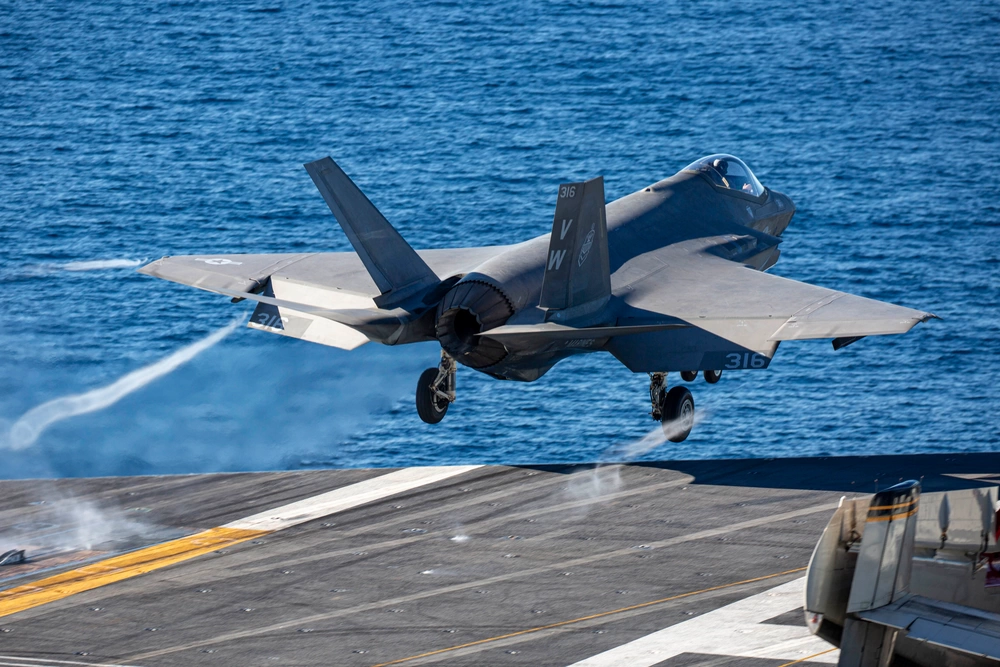
With its current two standard (non-stealthy) drop tanks under wing providing 4,000 additional pounds of fuel each, the Raptor’s one-way ferry range extends to roughly 1,800 miles. The new tanks are said to carry a “similar” amount of fuel to the non-stealth ones, which could realistically stretch the upgraded Raptor’s combat legs to more than 800 miles, exceeding that of even the farthest-reaching F-35, the Navy’s F-35C.
Lockheed officials say the Low Drag Tank and Pylon systems are already in production for the Raptor fleet. They’ll be added alongside infrared search and track pods that are being installed further outboard on the wings; improvements to the fighter’s Pratt & Whitney F119 turbofan engines for more power and better reliability; and a new open system software architecture meant to allow for additional updates and upgrades down the line.
Feature Image: A production representative model of an F-22 with its new stealth fuel tanks. (Photo courtesy of author)
Read more from Sandboxx News
- Northrop Grumman and Air Force agree to expand B-21 production capacity as program performs well
- DARPA’s new Longshot missile will begin testing this year, the agency says
- British Army’s new SONUS system will use acoustic pressure to track enemy artillery
- These five firearms died at the prototype stage, but their influence is still felt
- How fighter pilots plan combat missions