On a future battlefield, an unmanned helicopter may touch down in a hot landing zone just long enough to disgorge a swarm of rugged robots on wheels or tracks. Autonomous and pre-loaded with a resupply mission criteria and parameters, they head off for their objective as the helo, also autonomous, lifts off to return to its dispatch point. The mission is precisely programmed, but no humans ever get close to the danger.
That’s one possible scenario that a recent first-of-its-kind air insert of an unmanned ground vehicle may help to validate.
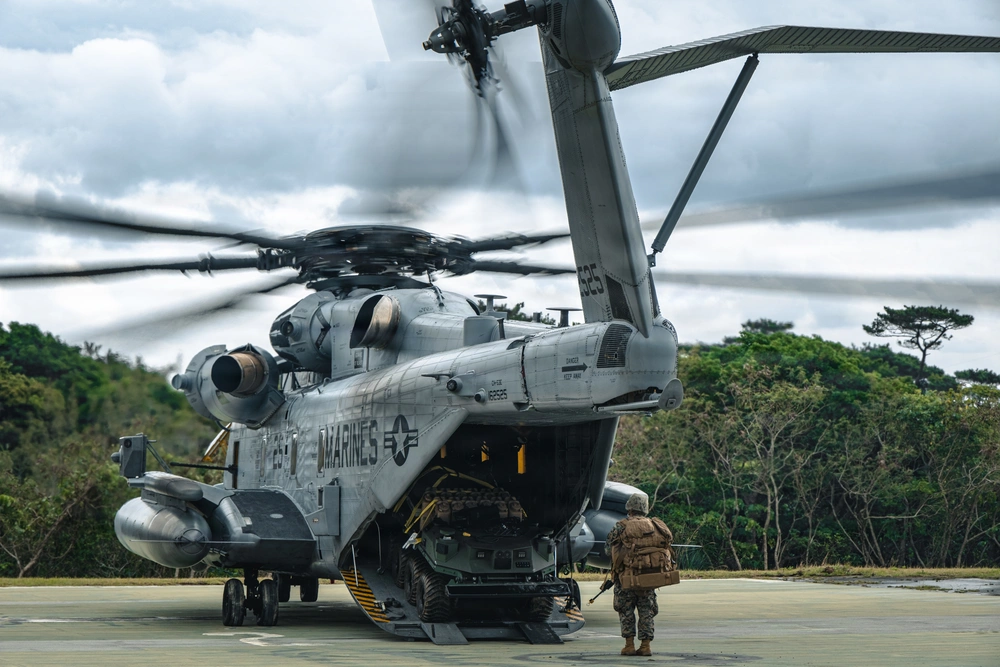
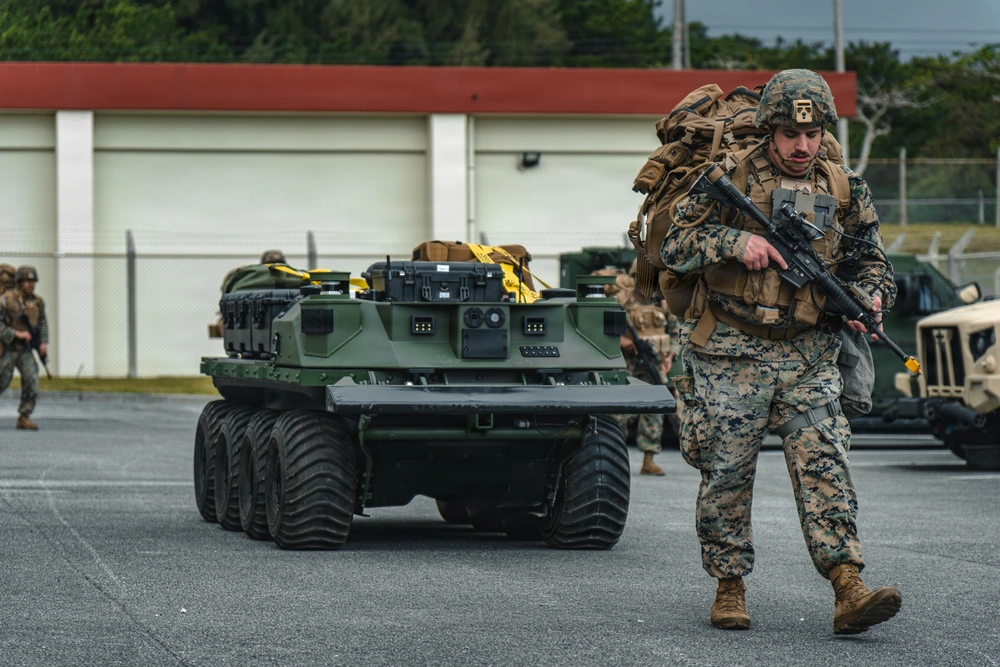
In late January, Japan-based Marines with 4th Marine Regiment, 3rd Marine Division used a CH-53E Super Stallion to airlift the vehicle, a Mission Master Silent Partner, MMSP, made by German company Rheinmetall. The mission was neither as kinetic nor as hands-off as the one described in the above scenario: instead, the MMSP, which is designed to silently follow dismounted soldiers, was functioning as a mobile combat operations center, housing servers, radios and communications gear for Marines on the move.
The squat MMSP, with eight rugged wheels, can resemble a flatbed mounted with a turret, or take other forms based on mission and payload.
“The [MMSP] excels in any scenario requiring stealth and agility,” Rheinmetall said in an information sheet about the system.
“This [autonomous uncrewed ground system] is built for forward and last-mile resupply missions, silent watch operations, and carriage of light payloads, such as section sensors and weapon systems. Compact and highly mobile, the [MMSP] follows light dismounted troops wherever they go, letting soldiers get closer to the enemy without being seen or heard,” the company added.
The MMSP can be deployed by parachute from an aircraft or towed from another vehicle, according to Rheinmetall; it can also be outfitted with tracks in place of wheels to keep it moving through deep snow or thick mud. It also comes equipped with a steel wire cable winch to assist in extracting equipment or debris, according to Rheinmetall.
Marines have been experimenting with MMSPs and other vehicles in the Mission Master family since 2023, testing out functions such as overwatch, casualty evacuation, and armed reconnaissance. In 2024, MMSP conducted a live-fire demonstration in Fort Clinton, Ohio.
But the Marines had not validated the ability of the CH-53 to transport MMSP until January, when 3rd Marine Division took the system up in a flight test.
“Transporting autonomous UGVs on various air platforms creates opportunities for small, efficient formations of Marines to enable a mission-adaptable capability that’s able to move across vast distances within the first island chain at a moment’s notice,” officials said in a release at the time referring to the Pacific island chain that limits China’s access to the Pacific.
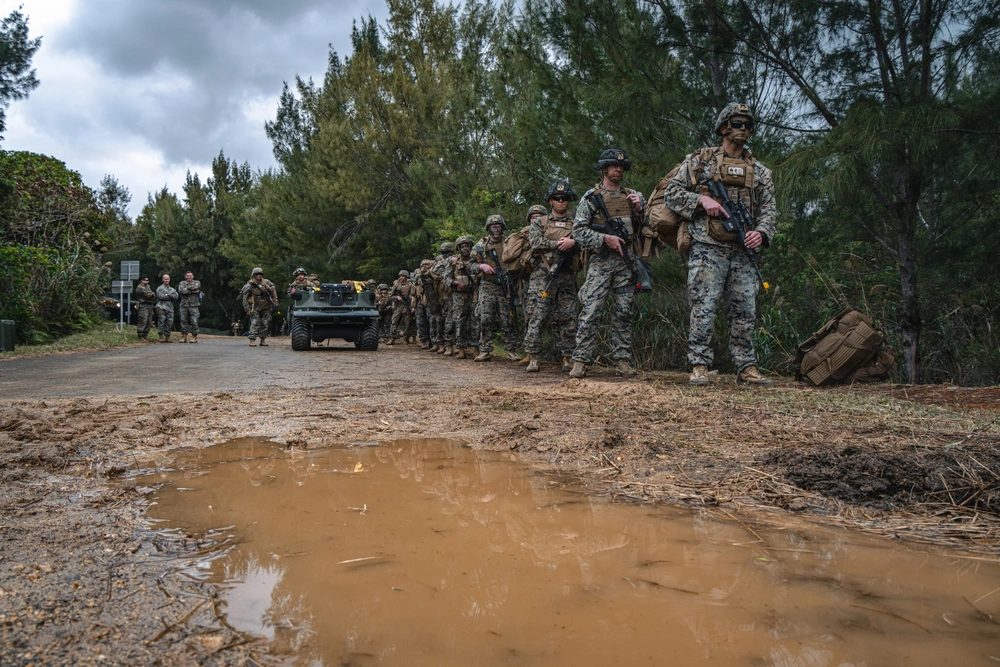
The air insert that took place a month later as part of 3rd Marine Division’s combined Marine Corps Combat Readiness Evaluation showcased a coveted Marine Corps operating concept: the ability for small groups of ground troops to move with agility through austere terrain in the Pacific with little remote support, carrying with them all essential capabilities for communication and defense.
In a release, officials said the idea of a foot-mobile regimental combat operations center would have been “nearly unthinkable” only five years ago and that the demonstration had shown that the Mission Master – particularly when air-inserted, could “comfortably” achieve the objective for days on end.
As the military continues its cautious integration of unmanned systems into manned combat formations, it’s notable that progress toward robotic vehicles as programs of record has not moved faster.
An article by Army Capt. Connor James, published in January, noted that service’s slow progress onward an unmanned ground vehicle solution for resupply.
Related: Army and Marines embrace kamikaze drones for ground combat
“Current U.S. Army UGV programs are expensive and unsuited for disposable or high-turnover logistics tasks,” James wrote. “Without cost-effective, adaptable alternatives, infantry units may face critical resupply gaps when the risk to human drivers is too great.”
He noted that the Small Multipurpose Equipment Transport, or SMET, perhaps the Army’s best-established UGV developmental program, costs around $100,000 per copy.
Meanwhile, Ukraine, which has pioneered use of UGVs for logistics, has a system, Vepr, that costs between $8,000 and $20,000, he wrote.
Yet, as James also pointed out, even the expensive UGVs are often cheaper – and more difficult for the enemy to destroy – than exquisite unmanned aerial systems.
Between conducting resupply missions too dangerous for manned vehicles, and freeing ground troops from the burden of carrying heavy comms suites, the use case for these systems, and their ability to do the job, is becoming exceedingly clear. The military must now decide if it needs to keep testing and developing rugged and exquisite versions of a system until it reaches a perfect solution, or move faster to field an acceptable version soon, giving troops a chance to familiarize themselves with the technology and discover its best application in the field.
Either way, the Robot Wars are getting closer by the day.
Feature Image: U.S. Marine Cpl. Bransyn Bridger, a Chemical, Biological, Radiological, and Nuclear Defense Specialist with 4th Marine Regiment, 3rd Marine Division, leads a Mission Master Silent Partner on movement to load onto CH-53E Super Stallions as a part of a combined Marine Corps Combat Readiness Evaluation on Camp Schwab, Okinawa, Japan, Jan. 28, 2026. (U.S. Marine Corps photo by Cpl. Joaquin Dela Torre)
Read more from Sandboxx News
- Lockheed Martin will quadruple production of sophisticated THAAD systems as US stockpiles diminish
- Army unveils its first new offensive hand grenade in nearly 60 years
- American and Israeli forces have struck more than 6,400 targets across Iran
- How have four years of war impacted the Russian military
- DARPA and SOCOM unveil X-76, their newest X-Plane designed to transport operators much faster than before