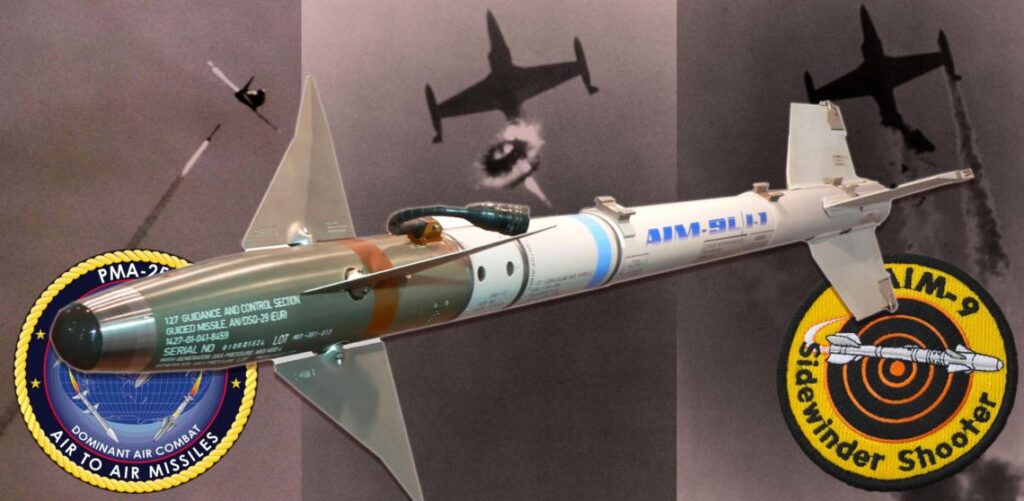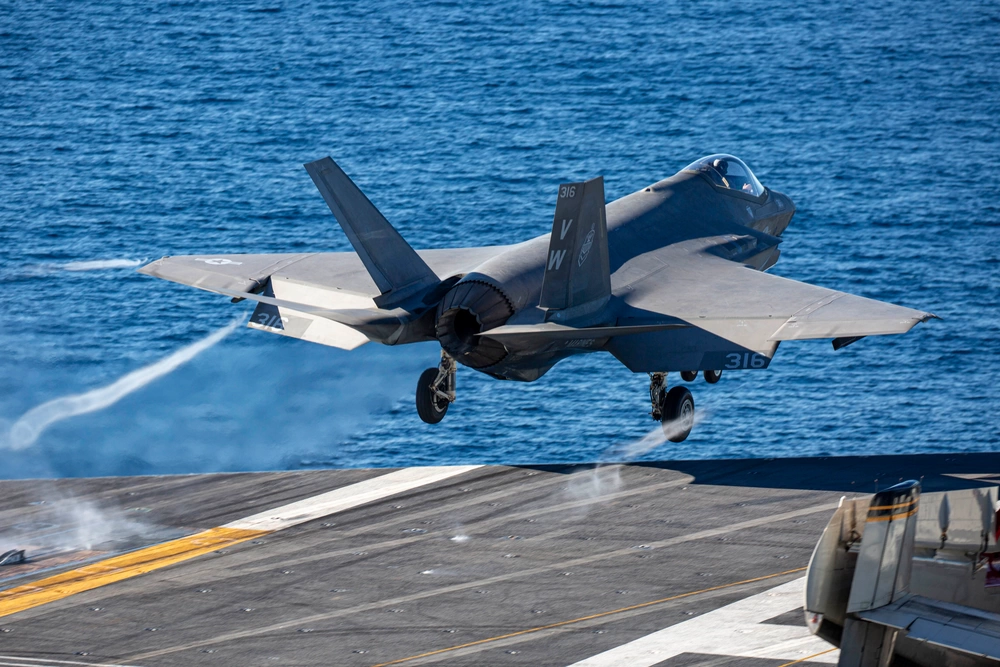
According to reports, an American F-35C just shot down an Iranian drone as it closed with the USS Abraham Lincoln aircraft carrier operating in the Arabian Sea. The only F-35s currently operating aboard the Lincoln hail from the Marine Corps’ VMFA 314, so it seems very likely that it was a Marine Corps F-35C that mounted the successful intercept.
The Abraham Lincoln was sailing roughly 500 miles south of Iran, in international waters, when the interception happened.
The Iranian drone was initially reported by several Western news outlets as a Shahed 139, though Iranian state media has reportedly identified the drone as a less advanced Shahed 129 instead. The two types are very similar platforms that are both generally considered to be copies of the American MQ-1 Predator, which became famous throughout the early days of the Global War on Terror.
Both the Shahed 129 and 139 have straight wings optimized for medium-altitude, long endurance missions and a piston-driven pusher propeller in its back. The Shahed 139 is considered an evolution of the older 129, which was generally equipped only for intelligence, surveillance, and reconnaissance missions.
It’s believed the 139 is capable of carrying to air-to-surface munitions. It’s also known to boast an electro-optical sensor turret and, according to reports, possibly even a small synthetic aperture radar array for gathering intelligence.
The F-35C – the aircraft type which took down the Iranian drone – is a unique variant of the F-35 line, with a wingspan that’s roughly eight feet wider than the runway queen F-35A or the vertical-landing F-35B. The wider wingspan allows the jet to land at lower airspeeds, making carrier landings more manageable, but also gives it greater fuel storage capacity. As a result, the F-35C boasts the greatest unrefueled range of any F-35 iteration. The F-35C, of course, also carries all the necessary hardware for carrier duty, including a reinforced fuselage and tail hook for arrested landings.
The Lincoln and its accompanying carrier strike group are in the Arabian Sea as part of a broader American show of force in the region following widespread protests in the streets of Iran and an extremely brutal crackdown on demonstrators from Ali Khamenei’s regime.
Besides the interception, today boats and at least one drone from Iran’s elite Islamic Revolutionary Guard Corps harassed and reportedly attempted to seize a U.S.-flagged merchant tanker in the narrow Strait of Hormuz. When the Iranian troops ordered the tanker to stop its engines and prepare to be boarded, the crew reportedly opted to speed up, instead.
The tanker was soon joined by the USS McFaul – a Flight II Arleigh Burke-class guided missile destroyer. The Iranian fast attack boats fled the scene once the American warship arrived.
All of the above incidents happened as the U.S. and Iran prepare to enter a new round of talks meant to curtail Tehran nuclear activity.
However, the real question is whether the massing American forces in the region will ultimately mount an attack on Iran’s ruling regime. Whereas this is uncertain, one thing is for sure: if Iran was trying to test America’s response to some light prodding today, it just got its answer in the form of an air-to-air missile and a destroyer.
Feature Image: PACIFIC OCEAN (Jan. 31, 2024) An F-35C Lightning II, assigned to Marine Fighter Attack Squadron (VMFA) 314, launches from the flight deck of the Nimitz-class aircraft carrier USS Abraham Lincoln (CVN 72). (U.S. Navy photo by Ensign Han A. Puyu)
Read more from Sandboxx News
- When Delta Force torched down the neighborhood
- Air Force to build realistic training ranges to enhance ‘airmindedness’
- Pentagon names China ‘second most powerful country’ since the 19th century, in latest National Security Strategy
- Project MAHEM was DARPA’s attempt at destroying armor by using electromagnetism
- The military wants to deploy ‘walking blood banks’ – and that’s a big deal