In the audience at the State of the Union address this week were four astronauts set to advance America’s Moon-return ambitions later this year.
NASA astronauts Victor Glover, Christina Koch, and Reid Wiseman, along with mission specialist Jeremy Hansen of the Canadian Space Agency, had seats of honor at President Donald Trump’s address before Congress. As soon as April, they’re supposed to launch from Kennedy Space Center in Florida on a lunar flyby known as Artemis II – what NASA says will be the first crewed mission around the Moon in more than 50 years. And while new tech problems have once again thrown the mission timeline into uncertainty, one reality remains constant: if and when NASA gets to the Moon again, it will be with substantial support from the U.S. military.
Fighter pilots onboard
As is typically true with NASA missions, several astronauts crewing Artemis II are seasoned military veterans. Mission commander Wiseman, a 27-year Navy veteran, is essentially Tom Cruise in Top Gun – but possibly cooler. Like Cruise’s Pete “Maverick” Mitchell, Wiseman’s first aircraft was the iconic F-14 Tomcat. He’d later transition to the F/A-18 Super Hornet, completing deployments to Iraq and Afghanistan, and participate in flight test programs with the F-35 Joint Strike Fighter.
In an interview with his alma mater, Rensselaer Polytechnic Institute, in 2024, Wiseman said the original Top Gun “influenced” his choice to fly the Tomcat.
“Top Gun was as close to my real life as a movie will ever get for being in the Navy. There was movie magic going on, but a lot of the commentary, the way they spoke, the things they were talking, were exactly on the money,” he said at the time. “And the sheer amount of physical demand was realistic.”
Test pilot Glover is also a Navy fighter pilot, test pilot, and weapons tester who flew the F/A-18 Hornet and Super Hornet, logging 3,500 flight hours across 40 different aircraft and completing 400 carrier “trap” landings and 24 combat missions. Glover actually advised Cruise on spaceflight and mission preparedness in an hourlong conversation released by NASA in 2022. (Cruise has reportedly scrapped plans to film a movie in space since then.)
In a conversation with students at Glover’s alma mater, Cal Poly, he revealed that his military call sign, “Ike,” stands for “I know everything.”
“Nobody gets Maverick from Top Gun, that’s too good of a call sign,” he said at the time. “Call signs are usually a reminder of something we did wrong or messed up. It’s constant education, if you will.”
Recovery mission
While the crewed mission has yet to secure a takeoff date, U.S. Navy platforms and personnel have been training for more than a year for the all-important task of recovering the astronauts when they return to earth.
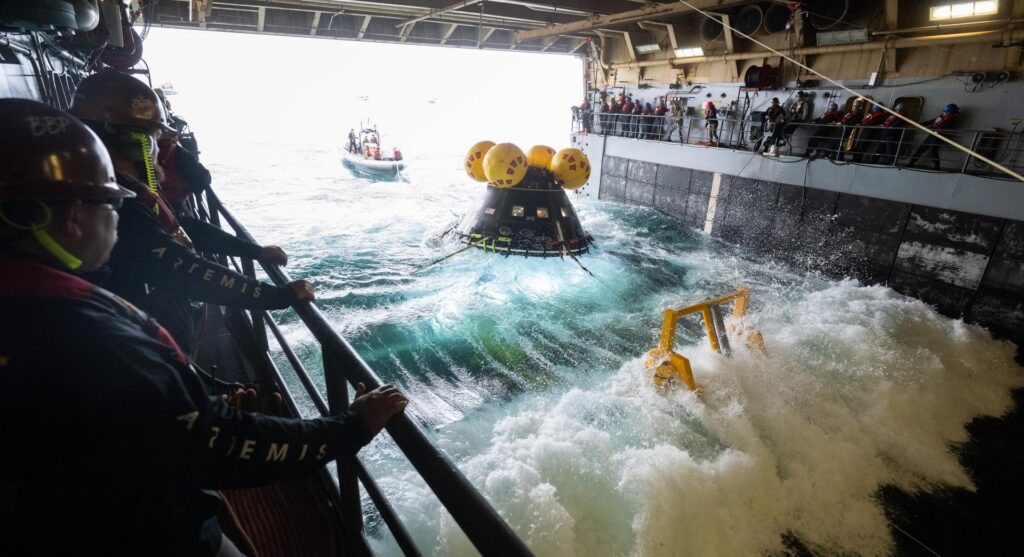
The San Antonio-class amphibious transport dock USS Somerset has been tasked with recovering the landing module at sea. Last March, the ship participated in an elaborate week-long drill with NASA personnel to rehearse every part of the recovery process.
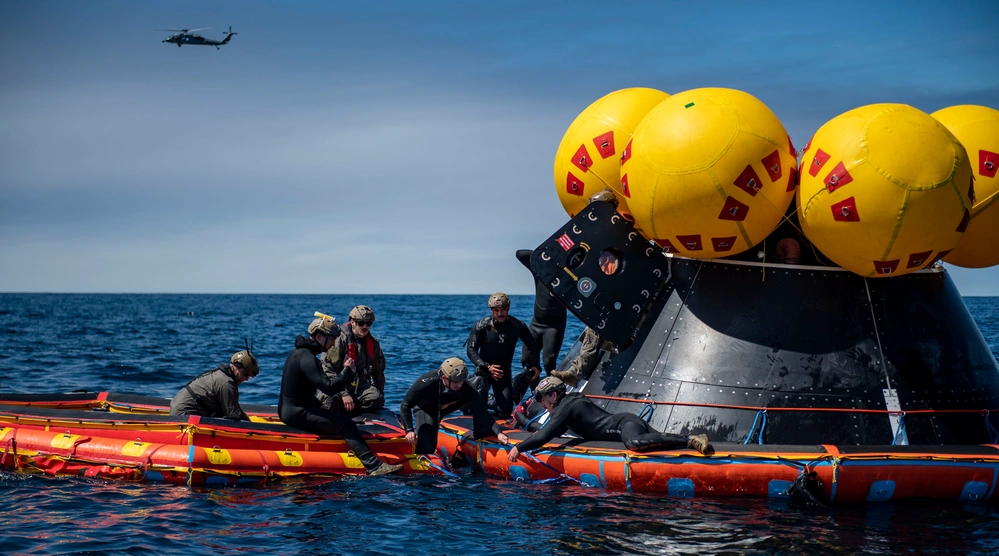
Off the coast of California, the ship’s crew worked with a full-size model of the Orion spacecraft known as the Crew Module Test Article. The objective is to recover the module into the Somerset’s well deck – the semi-submerged lower ship deck that allows for the launch and recovery of landing craft and amphibious vehicles. While the Navy-NASA team drills on a variety of scenarios and contingencies, the objective is for Navy divers to meet the module when it splashes down and attach a “connection collar” linked to a winch that will initiate a tow into the well deck.
“A team of sailors and NASA recovery personnel inside the ship manually pull some of the lines to help align Orion with its stand, which will secure the spacecraft for its trip to the shore,” NASA officials said in a release last year. “Following a safe and precise recovery, sailors will drain the well deck of water, and the ship will make its way back to Naval Base San Diego.”
Amphibious ships have traditionally been the platform of choice for NASA recovery missions. In addition to their unique well deck capability, they’re also fast: as USNI News noted last year, the Somerset can cruise at more than 24 miles per hour, covering distance in the vast Pacific where the precise splashdown location is uncertain. And the ship’s flight deck will hold Navy MH-60 helicopters – alongside its typical complement of MV-22 Ospreys and rotary- and fixed-wing aircraft – to extract the astronauts from their capsule with all possible haste.
Parachute testing
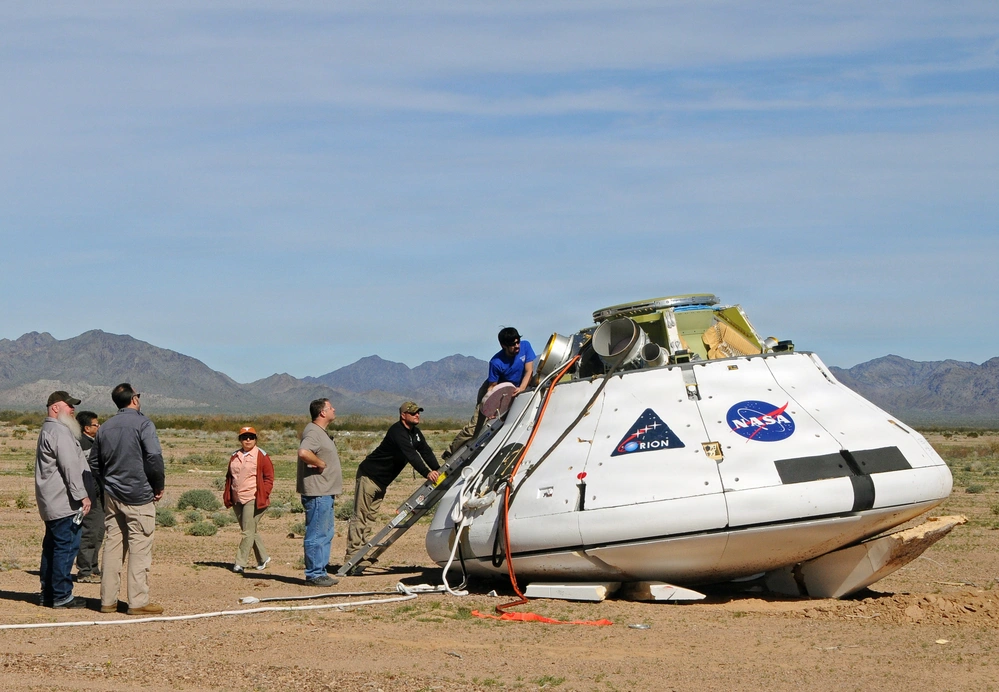
Along with behind-the-scenes functions such as contracting support, the military has provided personnel and test sites to evaluate critical equipment used in the mission. That includes the parachutes that will assist the Orion space capsule on its final journey back to Earth. The Capsule Parachute Assembly System, or CAPS, was developed and tested over a period of seven years at Yuma Proving Ground, AZ. The evaluations done there resulted in some critical improvements, including using Kevlar, rather than steel, in the parachute’s cord, according to Pentagon officials in a January release.
The entire system is specially designed for space capsule recovery and includes 11 parachutes, each of which has 10,000 square feet of fabric – roughly a quarter of an acre.
Not all of the parachute testing took place at Yuma. Since the CAPS is designed to land in the ocean, it was also dunked in the Johnson Space Center’s 62 million-gallon Neutral Buoyancy Lab tank. But four critical pilot flight tests were completed between there and the Navy’s China Lake Naval Weapons Station, CA, including drop tests and harness torque tests.
The goal was to slow the capsule’s descent, with four astronauts onboard, from 24,500 miles per hour to just about 17 mph, or slower than a good roller coaster ride.
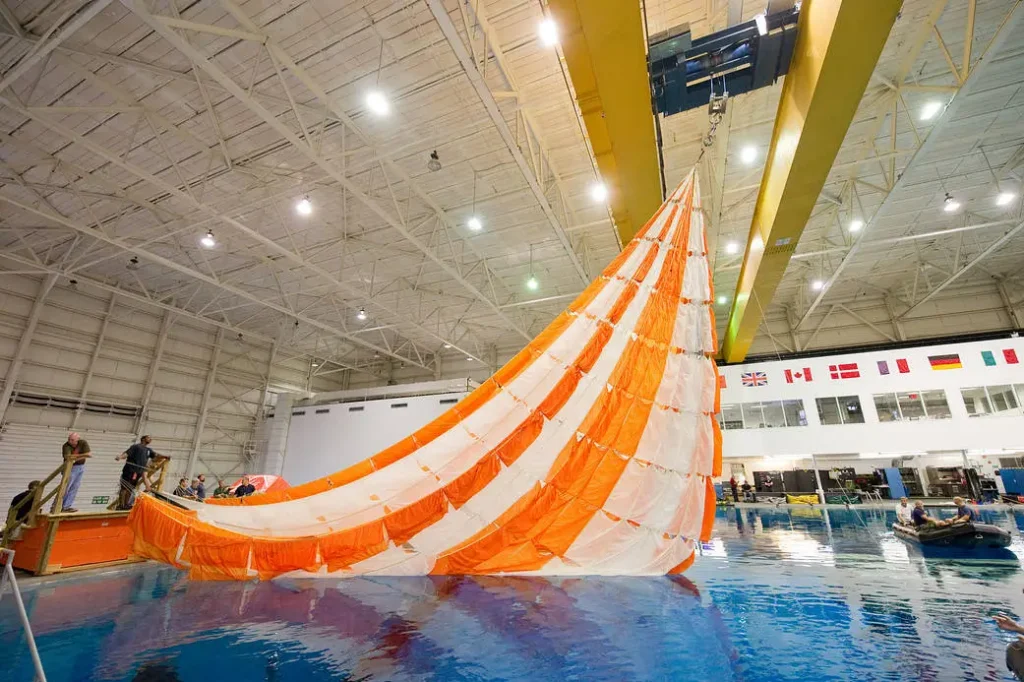
“The parachute system is designed with redundancies to ensure a safe landing for astronauts, even in extreme scenarios such as two parachutes failing or a catastrophic mishap shortly after takeoff,” military officials said in a Pentagon release this year. “In many of the tests at the proving ground, evaluators intentionally rigged one or more of the Capsule Parachute Assembly System’s parachutes to not deploy, which tested if the remaining functioning chutes could withstand the additional stress of speed and mass that the failure would cause.”
Orion last splashed down in December 2023 after the conclusion of the uncrewed Artemis I mission, with the parachute system working exactly as advertised.
Artemis II, which was pushed back in scheduling earlier this month due to a helium pressurization system malfunction, aims to send the four astronauts on a 10-day “slingshot” mission around the Moon that will not involve an actual landing. Artemis III, which is now tentatively slated to launch in 2028, would see humans back on the surface of the Moon for the first time since 1972.
Feature Image: Sailors assigned to Explosive Ordnance Disposal Group 1 prepare to open the door of the crew module test article during NASA Underway Recovery Test 12 in the Pacific Ocean, March 27, 2025. (U.S. Navy photo by Petty Officer 2nd Class Nettie Mae Manfull)
Read more from Sandboxx News
- Former Air Force pilot and instructor accused of training Chinese pilots in American systems and tactics
- Poland exits mine treaty and could soon mine its border within 48 hours in response to Russian aggression
- Ukrainian counteroffensive is making ground and easing pressure on country’s defenses
- Army pilot shot three times during the Maduro Raid just received the Medal of Honor
- Lockheed Martin reveals F-22’s new stealth fuel tanks during Warfare Symposium