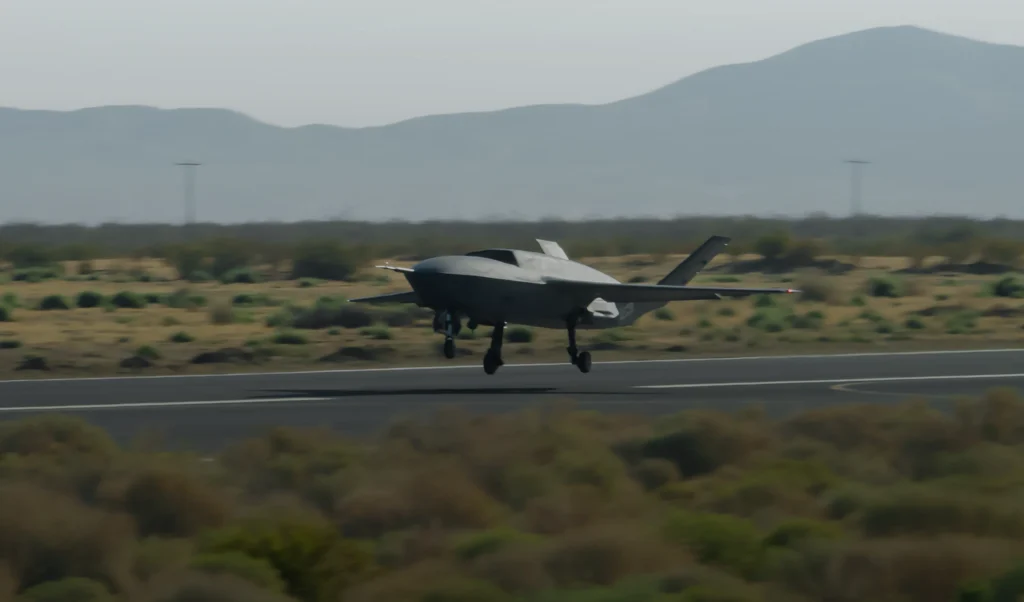
On June 17, the Air Force announced the award of the first Collaborative Combat Aircraft contracts. The awarded contracts are for the CCA drones themselves and separately for the mission autonomy software system that will power them.
The Air Force launched the Collaborative Combat Aircraft program in 2023 with the purpose of fielding semi-autonomous drones that would operate alongside manned 5th- and upcoming 6th-generation aircraft to extend the aircraft’s range, survivability, and capabilities.
“Building upon decades of responsible, semi-autonomous flight development, CCA represent the next critical evolution of airpower,” the Air Force wrote in the contract announcement.
“This human-machine teaming will serve as a powerful deterrent, signaling to adversaries the futility of challenging U.S. airpower,” it added.
Several companies have been building aircraft and software for the CCA program.
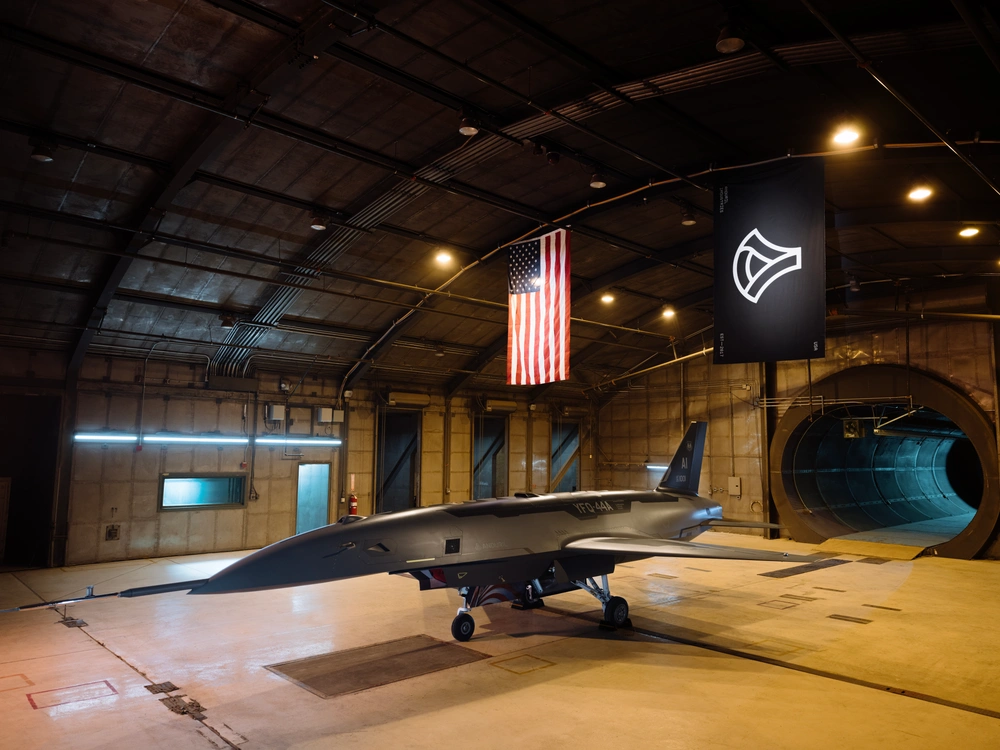
Now the Air Force awarded General Atomics and Anduril Increment 1 contracts for their FQ-42 Dark Merlin and FQ-44 Fury drones respectively. In awarding the contracts, the branch evaluated both the candidate systems’ capabilities as well as their cost-effectiveness.
Increment 1 focuses on a system’s core capabilities and features, and acts as a basis for further additions and upgrades.
According to the Air Force, the Increment 1 contracts were awarded four months ahead of schedule and “signify that the FQ-42 and FQ-44 meet rigorous mission requirements and are ready for full-scale manufacturing.”
Production representative prototypes of both drones have already been flown.
The branch did not state for how many drones each of the Increment 1 contracts are, although Secretary of the Air Force Tony Meink mentioned that the goal is to procure 150 combat-capable CCA by the end of the decade, and the branch has stated that it wants to field combat-capable 1,000 CCA overall.
“By moving fast from competitive selection into full-scale manufacturing, we position ourselves to field highly credible and combat-ready semi-autonomous systems to stay ahead of the pacing challenge,” Meink said.
Related: Keeping top combat aircraft flying is expected to only get more expensive, consulting firm says
On the other hand, the six-year contracts for the mission autonomy software system that the drones will operate went to Anduril, Shield AI, General Atomics, Lockheed Martin, Northrop Grumman, RTX Collins Aerospace, and Shield AI.
Anduril, RTX Collins Aerospace, and Shield AI were also awarded six-month-long production options to “accelerate the delivery of critical mission autonomy software.”
After six months, the Air Force will evaluate the progress the three companies have made on the critical software and award a second six-month-long production option.
“Mission autonomy is the cornerstone of the CCA concept, and leveraging a competitive, multi-vendor environment ensures we capture the latest technology,” Meink said. “This approach guarantees our Airmen are equipped with state-of-the-art capabilities today but keeps the door open for the breakthroughs necessary to maintain air superiority,” he added.
In making the selection for the second six-month option, the Air Force will also consider operator feedback and combat performance.
Importantly, for the CCA program, hardware and software contracts are awarded separately from each other to decouple hardware and software procurement. The Air Force refers to this decoupling as a critical operational advantage.
“By treating mission autonomy as ‘software sold separately,’ the Air Force ensures that the warfighter receives state-of-the-art physical platforms alongside agile, easily updatable software, effectively breaking traditional procurement molds,” the branch said.
To enable that, all CCA will have an open-systems architecture.
“Open systems architecture is critical in modern warfare,” Air Force Chief of Staff Gen. Ken Wilsbach said. “It allows us to capitalize on the most advanced autonomy solutions to ensure we incorporate the best technology in our weapon systems,” Willsbach added.
Feature Image: A YFQ-42A Collaborative Combat Aircraft takes off during flight testing at a California test location. The aircraft was developed in partnership with General Atomics as part of the Air Force’s effort to accelerate delivery of affordable, semi-autonomous aircraft. (General Atomics)
Read more from Sandboxx News
- Advice on self-discipline from an F-35 pilot instructor
- How Delta Force operators dealt with a leaky roof in their compound
- Big Tech executives are joining a special Army unit as reservist senior officers
- U.S. Air Force’s KC-46A tanker headache might finally be over
- SOCOM wants hypervelocity rifle system to shoot experimental rounds