
Land Navigation
“Basic Warrior Training (BWT)”
Week 9 focuses on building a strong combat mindset, covering essential skills like fireteam formations, camouflage techniques, and land navigation. Each aspect prepares recruits to operate effectively in tactical situations, enhancing their readiness for the challenges of Marine Corps service.
This crucial training not only builds essential skills but also fosters teamwork and resilience, preparing them for the challenges ahead. Let’s dive a little deeper.
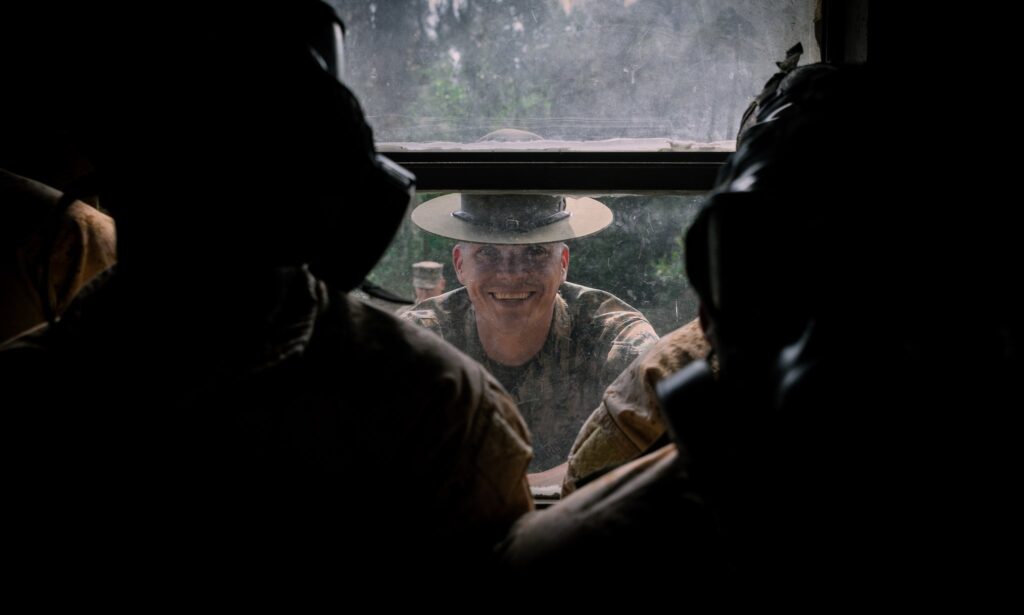
Navigating With Confidence – Day and Night Land Navigation
This week, Recruits begin mastering one of the most important warrior skills in Marine training: land navigation. Before stepping into the woods, they learn the fundamentals—how to read a military map, use a compass accurately, and plot grid coordinates with precision. These skills form the foundation of independent decision-making and battlefield awareness.
Once they’ve grasped the basics, recruits move from the classroom to the field, where they put their knowledge to the test during both day and night land navigation courses. In the daytime, they learn to read the terrain, trust their pace count, and make deliberate decisions as they search for hidden checkpoints scattered across challenging terrain.
At night, the difficulty increases dramatically. With limited visibility and relying only on their compass, training, and inner confidence, recruits navigate through darkness—proving to themselves that they can stay calm, focused, and mission-oriented even when the path isn’t clear.
Day and night land navigation doesn’t just teach technical skills; it builds self-reliance, mental toughness, and the confidence to lead under pressure. Each successful checkpoint is another step in their transformation into a Marine.
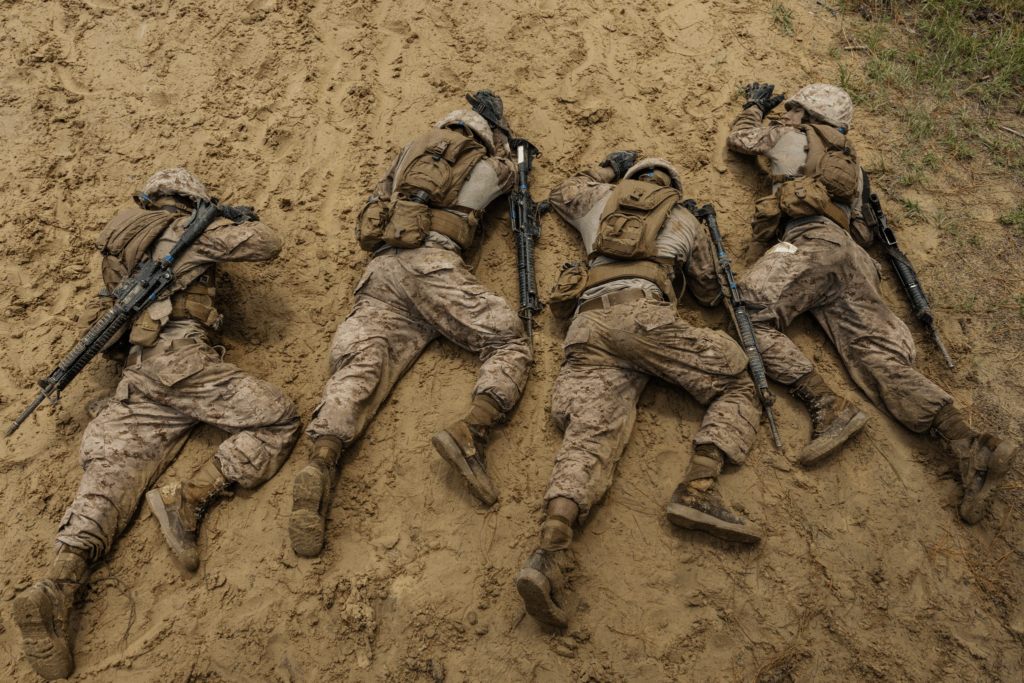
Combat Skills – Building the Warrior Mindset
Next, Recruits move straight into the core of Basic Warrior Training (BWT)—the hands-on, field-focused portion of boot camp where they begin truly thinking and operating like Marines. This is where the classroom ends, and real-world combat skills begin to take shape.
During BWT, Recruits learn how to communicate silently through hand-and-arm signals—the universal language used on the battlefield when noise discipline is critical or when verbal commands can’t be heard. These signals convey movement directions, warnings, formations, and tactical commands, allowing Marines to coordinate as a team even under stress or in chaotic environments. Mastering this silent communication builds trust, awareness, and confidence within the unit.
Recruits also begin practicing fireteam formations, the structured ways four Marines move together depending on terrain, visibility, and mission. Whether advancing in a wedge, moving in a column, spreading out in a line, or shifting into skirmisher formations, Recruits learn how proper spacing and positioning keep the team safe and effective. These formations form the backbone of small-unit tactics in the Marine Corps—every movement is deliberate, disciplined, and rooted in teamwork.
Camouflage, Cover, and Concealment
One of the core lessons this week focuses on the essential fieldcraft skills Marines rely on in combat. Recruits learn how to properly apply camouflage to blend into their surroundings—using natural vegetation, face paint, and uniform adjustments to break up their outline and become harder to detect.
They also learn the life-saving difference between cover and concealment:
- Cover provides actual protection from enemy fire—solid objects like large trees, rock formations, walls, or terrain features.
- Concealment hides a Marine from view—bushes, tall grass, shadows, or uneven ground—but does not stop incoming rounds.
Understanding how to use both effectively is essential for survival, movement, and mission success on the battlefield.
As BWT progresses, Recruits begin to think, move, and operate like Marines. They learn to trust themselves, trust their training, and trust each other. Each lesson brings them one step closer to the moment they’ve been striving for: proving they have the heart, skill, and determination to earn the title Marine.
Gas, Gas, Gas
Next up Recruits will undergo the Confidence Chamber exercise, a controlled training environment aimed at teaching them to properly and confidently utilize their gear, particularly their gas masks. This exercise instills essential skills that are vital for their safety and effectiveness in handling potentially hazardous situations. Despite its intimidating nature, the Confidence Chamber serves as a pivotal milestone in their journey, empowering recruits with the knowledge and confidence to overcome obstacles with courage and resilience.
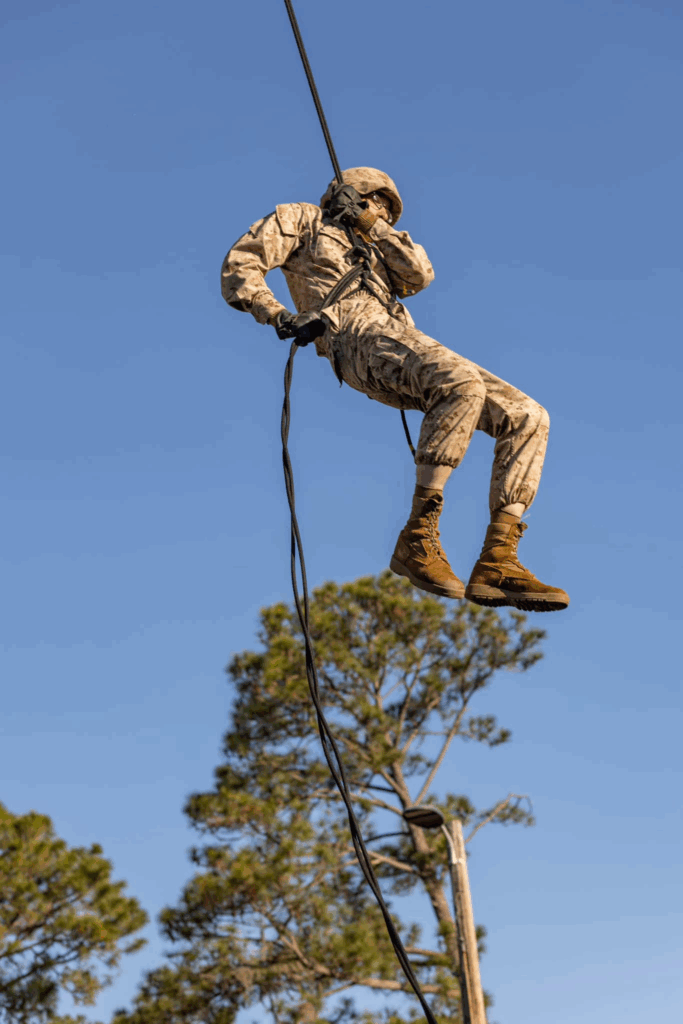
Conquering Heights and Endurance
After completing the confidence chamber, Recruits take on one of the most thrilling and demanding portions of training—conquering both the Rappel Tower and the Endurance Course, two events designed to push them beyond self-imposed limits and strengthen their confidence as future Marines.
Recruits begin by learning to master the Rappel Tower, a towering structure that challenges them to trust their equipment, their training, and themselves. Under the close guidance of their drill instructors, they learn proper rappelling techniques and safely descend a vertical wall while maintaining control, discipline, and focus. This event forces recruits to confront fear head-on, building the mental toughness needed to operate under pressure.
They are then introduced to fast-roping, a rapid descent technique used in real-world military operations. Unlike rappelling, fast-roping requires recruits to slide down a thick rope without a harness, relying solely on grip strength, body control, and mental determination. It’s a true test of courage, confidence, and composure.
To close out the week, Recruits take everything they’ve learned and apply it during the Endurance Course, a grueling combination of climbs, crawls, obstacles, and sprints. The course is designed to drain the body but sharpen the mind—teaching recruits to push past fatigue, support their fellow Marines, and finish strong no matter the challenge.
Together, the Rappel Tower, fast-roping, and the Endurance Course form a powerful trio of confidence-building events. These experiences show recruits that with proper training, discipline, and an unwavering spirit, no obstacle is too high and no challenge is too great. Completing them marks an important milestone on their path to becoming United States Marines.
Gear Up for the Crucible
Now’s a good time to send another Marine Corps Exchange (MCX) gift card. Your Recruit will have the opportunity to visit the MCX next week before they begin, and this can help them stock up on any essential supplies they need before and after “The Crucible.”
Next week—“The Crucible”. Enough said.
I’m SgtMaj Paul Davis (USMC Ret), and I can’t wait to share more with you about this incredible journey.
Semper Fidelis